

The haunting of bushrang.., p.1
The Haunting of Bushranger Inn, page 1


***
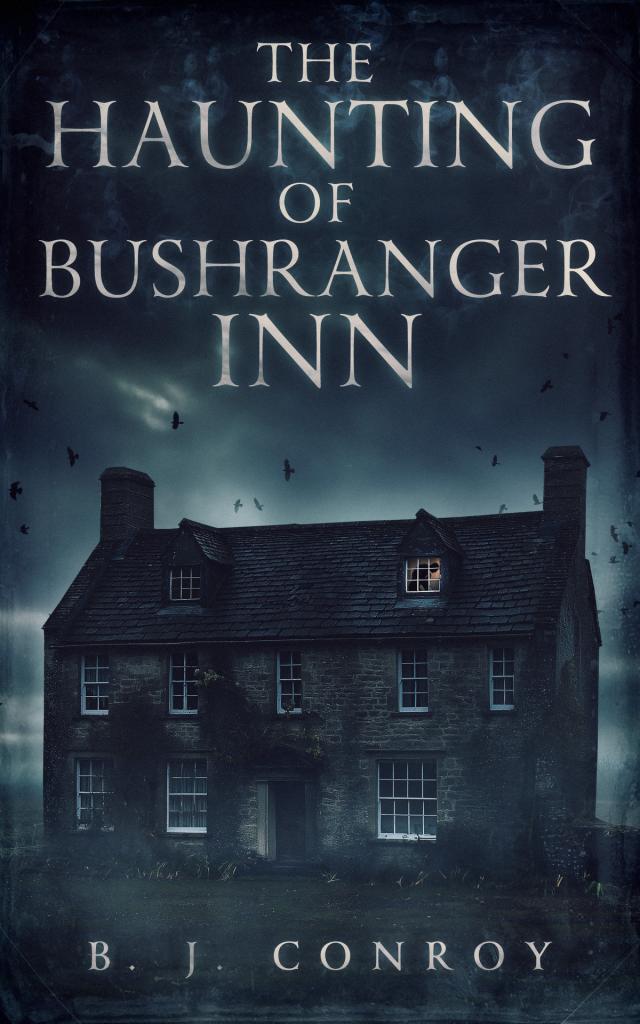
The Haunting of Bushranger Inn
By B. J. Conroy
***
Kindle Edition
Copyright © 2024 B. J. Conroy
All Rights Reserved
***
To my wife, Dawn Ellis, for all her love and support
***
Cover Design by www.ebooklaunch.com
***
For more about the author visit:
https://bjconroy.com/
***
Table of Contents
Chapter 1 - 1863
Chapter 2 – Present Day
Chapter 3
Chapter 4
Chapter 5
Chapter 6
Chapter 7
Chapter 8
Chapter 9
Chapter 10
Chapter 11
Chapter 12
Chapter 13
Chapter 14
Chapter 15
Chapter 16
Chapter 17
Chapter 18
Chapter 19
Chapter 20
Chapter 21
Chapter 22
Chapter 23
Chapter 24 – Mrs. Dodd Part 1
Chapter 25 – Mrs. Dodd Part 2
Chapter 26
Chapter 27
Chapter 28
Chapter 29
Chapter 30
Afterword
Books by the Author
Chapter 1 - 1863
Sergeant Dodd shifted his position on the hard wooden seat but remained uncomfortable. It was a hot, sticky summer’s day, and he was sweating in his heavy woolen tunic beneath the sun’s unrelenting glare. Still, it was better to be here, sitting on the box seat of the carriage next to the driver, enjoying the fresh air and watching the team of four horses working hard rather than stuck inside in a stifling sweat box like the four men under his command.
Squatting between those men was a wooden chest bound with thick leather straps and secured by sturdy iron padlocks. It contained the reason for their journey. Gold!
The town of Soames had been a country backwater until two years ago when a farmer discovered fragments of gold in a creek bed. Now, the gold fields around Soames operated night and day, and the town was booming.
Sergeant Dodd flicked his hand to disturb the flies buzzing around his face. In a roundabout way, the gold had reached out and drawn him and his beloved mother to Soames, but not from greed and dreams of wealth.
What a rapidly expanding mining town needed was law and order. He was a policeman, a good one, and proud of it. His superiors thought so, too, and eighteen months ago, they had dispatched him to Soames to help police it. Mother had moved with him to keep house as she always did.
He knew people whispered about him behind his back: “Thirty years old and still living with his mother, what’s wrong with him?”
Girls had taken an interest in him, but Mother had always vetoed them with a shake of the head and the words: “She won’t make you happy.”
Then, six months ago, Maeve O’Connor arrived in Soames as the new teacher at the local school. She had done the impossible and won Mother’s approval, mainly by remaining charming while not being in the least intimidated by her.
The sergeant smiled and gently ran his fingers over the left side of his tunic. He felt a small lump beneath the material. Sitting in an inside pocket was his most precious possession, a silver locket containing a portrait of Maeve, proof that the most valuable things in life had nothing to do with gold.
Stop that, he told himself. Love was wonderful, but he had a job to do and needed to stay alert. If nothing else, he had a loaded rifle on his lap, and he didn’t want any accidents.
The driver beside him failed to stifle a yawn. Sergeant Dodd hated admitting it, but he, too, was feeling drowsy. The summer heat and humidity left him feeling sticky and drained.
They had left the town of Soames at seven that morning, and progress had been good. At midday, they had passed through the sleepy hamlet of Tilda. An old woman watching them from her verandah had given them a wave; nothing else had stirred the sluggish air.
That had been about an hour ago. With luck, they would reach Mulberry, 25 miles from Soames, in a couple more hours, where they would unload the chest for the night and place it in the lockup. The next day, they would put it back in the carriage and take it a further 25 miles to the railhead at Crowther. After that, it would be put on a train to Sydney, no longer Sergeant Dodd’s responsibility.
The rhythmic jolting of the carriage on the rutted road allowed Sergeant Dodd’s mind to wander. When was he going to propose to Maeve? Other men were interested in her, including Frank Morgan, not that he needed to worry about him. Maeve was too sensible to be taken in by his sleazy charms.
Everyone in the district knew that Frank Morgan had an uncanny ability with horses. Those who had received a classical education talked of the centaur, a beast half man half horse, when they saw him ride. Most people also knew that he and his mates were horse thieves, but the police had never succeeded in making any charges stick.
The sergeant had confronted Frank Morgan and warned him to stay away from Maeve’s school. Morgan had been performing his flash horse tricks in the schoolyard, showing off and disturbing the lessons.
Frank Morgan’s most distinctive feature was his eyes, pale blue with an icy sparkle. During the sergeant’s speech laying down the law, Frank Morgan’s face had remained still and respectful, but the sparkle in his eyes had suggested either anger or mockery, possibly both.
A change in the landscape brought Sergeant Dodd out of his reverie. Between Soames and Tilda, swathes of faded green grass had been dotted with sheep, cows, and an occasional farmhouse. Now, a few miles beyond Tilda, the signs of farming, the fences, the buildings, and the animals had disappeared. They were heading into an untamed country.
Sergeant Dodd banged on the roof of the carriage. “Keep an eye out, dangerous country ahead,” he called to the men inside. “And curse the name of Eustace Merrywether,” he muttered under his breath.
Eustace Merrywether, the new Inspector of Police for the Soames district, had chosen to put the lives of everyone on board the carriage in far more danger than they needed to be.
He was what they called a ‘new chum,’ fresh off the boat from England. His knowledge of both police work and the colony of New South Wales was almost non-existent, and he was too arrogant to ask for help. It irked Sergeant Dodd, who had risen in the police force probably as high as he would be allowed to go, that the top jobs were handed out to English gentlemen.
Merrywether had been given plenty of advice about the safest routes for the gold shipment. He had chosen to ignore it, saying those routes were too slow. Really! How fast did the gold have to travel? The priority was that it arrived.
What concerned Merrywether was that criminals might learn about the shipment while it was in transit. His solution was to take the fastest route despite it carrying the greatest risk of ambush. He believed that with appropriate secrecy, the gold would have been successfully transported before anyone knew that it was on the move.
Merrywether’s decision to send off the gold shipment resulted in Sergeant Dodd having to change his plans abruptly.
The sergeant sighed and shifted his position on the box seat. He and Maeve had arranged to go out riding today; she was a fine horsewoman. It would have given him a chance to sound her out about marriage before rushing in with a proposal. Instead, the previous night, he had been forced to tell her that his superior was sending him off for four days.
“Anywhere special, Edward?” Maeve had asked him.
“Not allowed to say,” he had said with an apologetic sigh.
Maeve had tilted her chin upward, looked down her nose at him, and put on a posh English accent, mocking Merrywether. “Egad, Sir, a gentleman must never reveal himself; such exposure would surely bring dishonor.”
He had burst out laughing.
“If it’s Crowther, can you come back with a roll of yellow silk for a new dress,” she had said. “I can let you have the money.”
“Don’t worry,” he had said and grinned. “I might even do better than that.” He knew a jeweler in Crowther. Perhaps he would have time to buy an engagement ring before the return leg.
Sergeant Dodd shook himself. Once again, he had let his thoughts drift when he should be concentrating.
The land was conspiring to hem in the carriage. To their left was low-lying swampy ground, covered by a patchwork of stunted trees that twisted up toward the sun. On the right, the land sloped up, and tumbled blocks of stone littered the hillside as if they had been thrown there. Straggling green bushes with blood-red flowers had clustered around them, pushing their tendrils into rocky cracks.
The road threaded its way between the swamp and the rocky slope like a delicate act of diplomacy, finding the ground between two opposing forces.
Sergeant Dodd swept his gaze from side to side. Nothing moved, and the air was still and sticky. The animals would be sheltering away from the heat. Snakes would be curled up beneath rocky overhangs, and even the lizards had made themselves scarce.
He glanced up. Birds were wheeling in the sky, hovering on the thermals, making no effort with their wings. He wondered what the countryside meant. The aborigines read it like a book, but for him, it merged into a meaningless sprawl of rocks and bushes.
The carriage rounded a bend. Ahead of them, a cart partially blocked
The carriage driver slowed down to allow his horses to negotiate their way around the obstacle safely.
In a single fluid motion, the carter straightened up and turned toward them, drawing two pistols from his belt. The man had a scarf across the lower half of his face, and he had blacked the exposed parts of his skin. It didn’t conceal his eyes, chips of pale blue ice that sparkled as he took aim.
Sergeant Dodd recognized Frank Morgan and raised his rifle. He was too late. His brain registered the kick of a pistol and a puff of smoke. A moment later, the bullet clipped his heart, and he toppled from the carriage dead.
Chapter 2 – Present Day
“Bushranger Inn is 200 meters on your left,” the satnav announced.
Sandy, in the passenger seat, felt a surge of excitement. “This might be the one,” she said.
Nate gave her a slow, easy grin, his hands relaxed on the wheel. “Maybe,” he said and shrugged his broad shoulders.
“I wonder if the bushranger angle is genuine,” Sandy said.
The bushrangers were nineteenth-century outlaws who raided farms, robbed banks, and held up stagecoaches. When the authorities pursued them, they disappeared into the vast hinterland of forest and scrub called the bush.
“Turn now,” the satnav ordered.
They turned off the road between two gum trees whose branches formed a welcoming arch.
Bushranger Inn lay ahead of them. It was a stone building, two stories high, topped by a steep slate roof with a pair of dormer windows. The estate agent’s website mentioned living quarters in the attic.
To their left was a smaller single-story stone building with a slate roof that matched the main building.
“That must be the stables,” Nate said. “They talked about that in the description.”
In front of the inn was a car park, empty except for a black SUV. A lady was emerging from it, the estate agent. She had a helmet of blonde hair and wore a cream jacket, dark skirt, and red blouse.
Nate parked their truck beside her, and they got out. It was the first Saturday in December, early summer in Australia, and the heat blasted them as they left the air-conditioned cabin.
“We’re Sandy and Nate,” Sandy said, introducing themselves.
“Meryl Todd,” the estate agent said, giving each of them a firm handshake. “You’re younger than I expected.”
The remark irritated Sandy. She and Nate were in their late twenties, but that didn’t mean they lacked the experience to succeed here. “I’ve worked in hospitality in Sydney,” she said, “both as a chef and doing front of house. I also have a Master in Business Administration degree, so I know how to handle the finances.”
“And I’m a qualified electrician,” Nate chimed in. “And I’m pretty good at the plumbing, carpentry, and tiling, not that I like to brag.”
“Point taken,” Meryl said, smiling and holding up her hands in mock surrender. “Bushranger Inn is your perfect opportunity. Let me show you inside, out of the sun.”
She led the way to the front door and unlocked it.
Nate paused to examine the mortar between the stones.
“The current owner has completed the restoration work, and the building is structurally sound,” Meryl said, “What remains to be done is fitting out the interior.”
“Why are they selling?” Sandy asked. “Cashflow?”
“Not so much that,” Meryl said. “They’re a middle-aged couple who were looking for a change of life. The restoration turned out to be an enormous job, and it took it out of them. I think they ran out of enthusiasm.”
“That won’t happen to us,” Nate said. “We love hard work.”
That’s true, Sandy thought, despite it sounding like a boast. Nate was happiest when he was doing something; sitting and chilling out was a challenge for him.
Their marriage was entering its second year, and they had talked about taking on a big project outside of Sydney. If it worked out, it would be wonderful to raise their future children in the countryside. She and Nate had been brought up in Sydney’s suburbs. There was nothing wrong with that, but it was predictable and dull.
“Welcome to the Bushranger Inn,” Meryl said, ushering them inside.
In front of them was an uncarpeted staircase going up. On their left was a large room, empty of furniture and furnishings, with the floorboards sanded back; to their right was a closed door.
“In the old days, this was the bar room,” Meryl said, leading them into the large empty room. “I don’t think you’ll have any problem obtaining a liquor license if that’s the route you want to take.”
Sandy looked at the room and saw a blank canvas full of potential. They could make it anything they wanted.
At the rear of the room, windows looked out onto an overgrown garden, while on the left, a door stood partially open.
“Has it always been called the Bushranger Inn?” Sandy asked.
“It was known as the Victoria Arms when it first opened in 1851,” Meryl said. “A speculator, Horatio Quinn, believed the main coach road west was going to pass this spot, and building an inn would make him rich. Sadly, the road never materialized, and he went bankrupt.”
“When did the name change?” Sandy asked.
“In the 1970s,” Meryl said. “People were really interested in Ned Kelly and bushrangers in general, and the owner at the time saw a marketing opportunity.”
“And did it have a real connection with the bushrangers?” Sandy asked.
“One hundred percent genuine,” Meryl said. “In the early 1860s, the landlord was John Fitzpatrick, a friend of Frank Morgan.”
That rang a few vague bells in Sandy’s memory. “The Morgan gang.”
Meryl nodded. “They were horse thieves, but Frank Morgan had bigger ambitions. Soames was in the middle of a gold rush then, and the authorities had to transport the gold back to Sydney. Frank and his gang robbed a carriage carrying gold worth ten million dollars in today’s money.” Meryl swept her hand around. “This inn was where the Morgan gang hung out; they probably planned the robbery in this room.”
They were interrupted by Nate tapping on the floorboards near the staircase. “Sounds hollow,” he said. “Cellar?”
“That’s right,” Meryl said. “In the old photos, that was where the bar used to be.”
“There’s a trapdoor here,” Nate said, hauling it up. He put on his phone’s torch app and shone it down the hole.
Sandy joined him, looking down. The walls were plastered and painted white.
A ladder descended. Nate swung his legs onto it and climbed down. Sandy did not join him as she disliked heights.
“Did the gold rush last long?” she asked.
“Only ten years,” Meryl said, “which would have been distressing at the time but has worked out well in the end.”
“In what way?” Sandy asked.
Meryl smiled. “They put up a lot of splendid buildings with the money from the gold, but then it abruptly ran out. Those buildings were left untouched over the years as no one had any money to replace them with new ones. Soames presents an authentic 1860s townscape, and the tourists love it.”
“They’ve done a good job with the damp proofing,” Nate said from below them, sounding impressed.
Sandy left him to it. He was in his element and would come up when he was ready.
She moved over to the partially open door on the other side of the room and poked her head around it. Light came from a window looking onto the garden. The room was empty of furniture, but it did have a fireplace with an ornate tiled surround and a carved oak mantlepiece.
“Is that an original feature?” she said, stepping into the room and pointing to the fireplace.
“I believe so,” Meryl said from the doorway.
Sandy found the room gloomy and dispiriting. She wondered why. Was it the single window letting in insufficient light or the dead leaves piled up in the fireplace grate?
“Just needs a fresh coat of paint, carpet, and a couple of pictures,” Meryl said, moving to her side. “This is a room that’s meant to be cheerful.”
Sandy nodded. The room was what you made it. She wasn’t seeing it at its best, but it had potential.
Meryl smiled. “So many things today are packaged and uniform. People want something unique. This room could be a real drawcard.”






