

The many shades of midni.., p.1
The Many Shades of Midnight, page 1
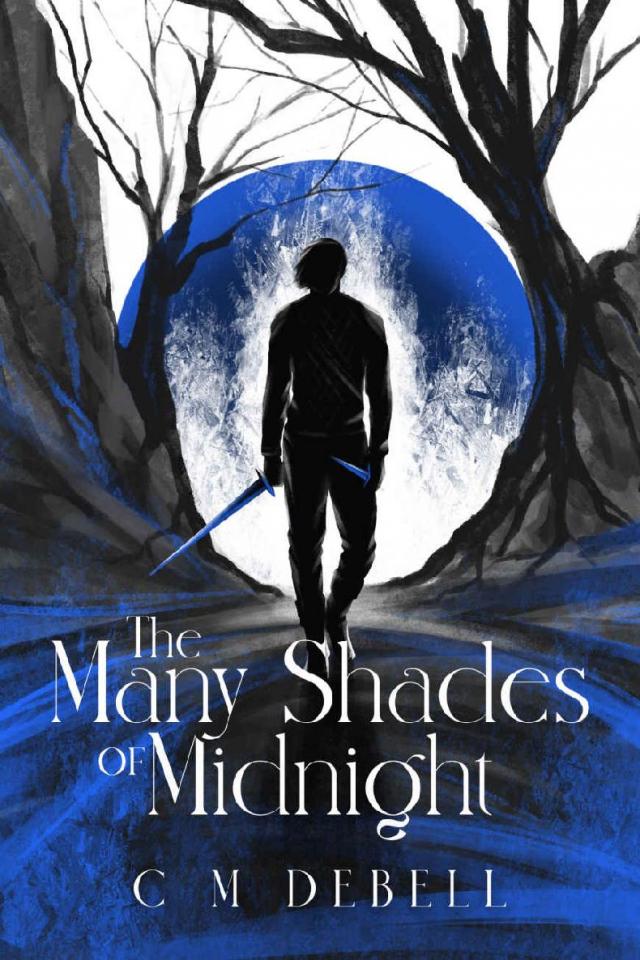


The Many Shades of Midnight
C M Debell
Copyright © 2023 C M Debell
All rights reserved
The characters and events portrayed in this book are fictitious. Any similarity to real persons, living or dead, is coincidental and not intended by the author.
No part of this book may be reproduced, or stored in a retrieval system, or transmitted in any form or by any means, electronic, mechanical, photocopying, recording, or otherwise, without express written permission of the publisher.
Edited by: Sarah Chorn
Cover design by: Mibl Art
PART ONE
1. BRIVAR
It was the first day of spring when they met the woodsman a week out from Orleas. For Brivar, apprentice surgeon and cousin of the king’s envoy to the erstwhile Duke of Agrathon, it was the day blue star-violet flowered. He longed to abandon his diplomatic duty and pick some, because there is no more potent painkiller in all the land than the dried blossom of blue star-violet harvested on the first day of spring. More importantly, it was also the day he met the Duke of Agrathon. That was the day his life changed forever.
Of course, Brivar didn’t know that then. At the time, the directions the woodsman gave them meant only that they were saved from one more night of sleeping under the stars, though with the pace his cousin set, Brivar would have preferred another night on hard ground to the harsh ache in his thighs from so many hours in the saddle.
And he quickly came to regret the lost opportunity to collect blue star-violet blossom on the first day of spring, because he would soon need it rather badly.
Perhaps that’s what the woodsman was looking for, out here in the wilds so far from any settlement. Certainly, as he stood a little off the path watching them with his hood drawn up, his stance was less easy than it should have been. Apprenticed to the guild of surgeons at the age of ten, Brivar was trained in observation. He knew how to read people, how they held themselves, how they moved and spoke, how to look for the truth beyond what words could convey—or conceal. His teacher, the Varistan Alondo, had a bad hip. Brivar always knew when it pained him by the way he walked, the stiffness when he sat, and those first few limping steps when he stood. Of course, he never complained or asked for help. Some people were too stubborn for their own good.
The woodsman looked like one of them. His attention reluctantly drawn from the temptation of blue star-violet, Brivar watched the forester spar with his cousin, observing the tension in his shoulders, the way he held his left arm close. An old wound, most likely, that had healed badly.
Brivar observed other things about him, too. The half-hidden worn leather sheathes for paired blades. Only professional soldiers and duellists used such weapons. Since you were unlikely to find a duellist wandering the wilderness, he had probably once served in a kingdom army, which made sense since he knew where the Duke of Agrathon was holed up. Once King Raffa-Herun Geled’s most trusted commander and confidant and now a renegade military captain whose fame had made him friends, and enemies, across half the continent.
And this one wasn’t giving him up easily.
Brivar’s cousin, the rather pompous Lord Sul-Barin Feron, had exhausted his meagre supply of patience. Brivar couldn’t understand why the king had chosen him for such a delicate mission. As far as he could see, his cousin was without an ounce of either subtlety or tact, as demonstrated by the way he lost his temper and his dignity arguing with a woodsman in front of the entire royal embassy.
It had started badly when Corado, the half-Flaeresian captain of their guard, had rudely hailed the man walking the track ahead of them, asking him where they could find the Duke of Agrathon. He had followed this with a flick of his whip when his question got no response, an insult the man had sidestepped easily enough but which had done their cause no favours.
Ignoring Corado’s glare, the man’s shadowed gaze skimmed their party and fixed on the ostentatious figure of Lord Sul. “I don’t know a duke.”
This was not well received. “Everyone knows the Duke of Agrathon. He is in these mountains somewhere. Tell me where and you can go on your way.”
It wasn’t a threat, though it could be taken as one when considered alongside the guard captain’s attempted assault. But Brivar had the distinct impression the man was amused rather than afraid.
“Who’s looking for him?”
“The King,” Lord Sul informed him with an arrogant tilt of his chin.
The man laughed. “Which one?”
“Which one? His king, man!”
There was a dangerous silence, which was almost certainly lost on Lord Sul. Then the man said, “The captain doesn’t have a king. Best remember that when you see him, or you won’t get far.”
“I’ll thank you to not give me advice,” Lord Sul snapped. “Just tell me where to find him.”
The woodsman gave a one-shouldered shrug. Definitely an old wound there, Brivar decided. He let his attention wander back to the carpet of blue star-violets as the man told his cousin what he wanted to know, and he wondered whether he would have time to pick some of the precious blossoms when they stopped for the night.
The woodsman’s parting words put paid to that hope. “You’ll have to hurry if you want to reach him before night falls. You’d be better off turning around and starting out again early tomorrow. You don’t want to be out after dark in these mountains.”
“I am well protected,” Lord Sul answered haughtily, hauling on his reins to wheel his stamping horse around.
Again, that awkward shrug, but there was a different tension to the man now. A kind of watchful stillness Brivar had observed in many old soldiers. For the first time since their journey began, he felt a touch of fear.
His cousin, of course, was oblivious to such things, and was not a man to take advice in any case. He was already waving his escort on, snapping at them to pick up their pace. He did not bother to look at their guide as he rode past. He certainly didn’t thank him.
Trailing at the back of the column, Brivar reined in as he passed. Careful that his cousin should not see or hear, he said quietly, “Blue star-violet, dried in the sun and crushed into a paste with spring water, is an excellent pain reliever.”
He sensed the man’s surprise and kicked his heels into his horse. He hadn’t gone more than a few paces when he heard him say, “I meant it about nightfall. It’s not safe.”
Brivar looked back, but the woodsman was already disappearing into the trees and his cousin was shouting at him to hurry.
✽✽✽
They were spared the perils of the mountains at night, but only just. Emerging from the forests of the lower slopes onto the mountain track, the woodsman’s directions took them quickly away from the main path into the depths of a canyon. The temperature dropped, the sting of cold edging Brivar’s fingers and misting his breath, and the fading light brought with it the wraiths of his imagination, crawling out of the rocks and from behind trees until all around him he felt the presence of their midnight threat.
There was a flicker of movement ahead and they were no longer alone on the track. The lead horses shied and Brivar started so hard he nearly toppled from his saddle. But the figures emerging from the twilight were merely human in shape, though they were armed, and their spears were pointed with definite intent at his cousin’s escort.
A woman stepped forward from the deep shadows lining the canyon walls. She pulled down the hood of her fur-lined coat to reveal a face that was as hard as it was young. “You’ve missed your way,” she told them, an uncompromising note in her voice. “Road to Orleas is two miles back.”
Lord Sul looked down at her with disdain. “We’re not looking for Orleas. We’re here to see the Duke of Agrathon.”
The woman raised an eyebrow. “Agrathon is two hundred miles to the west.”
His cousin, Brivar saw, had had enough. Ignoring the threat of the spears, Lord Sul stalked his horse up to the woman. “He’s not in Agrathon. He’s in these mountains. I demand that you take us to him this instant, in the name of King Raffa-Herun Geled.”
The woman gave Lord Sul a level stare. “That name means nothing here.”
Brivar heard a hiss of outrage from the guardsman to his right as his captain surged forward, sword in hand. There was an answering movement in the shadows and they were surrounded by drawn bows as well as ready spears. Brivar clutched the pendant of Yholis in his left hand and his voice shook through a muttered prayer.
“Hold!” The woman raised her hand and the archers stepped back, bows dropping but arrows still nocked. “Not here.”
She made a gesture and one of the spearmen turned and disappeared through a cleft in the canyon wall. Brivar’s stomach churned in an unpleasant manner. He thought he might be sick but he was too afraid to move.
Lord Sul snapped, “I demand –”
The woman put a hand on his bridle, her touch calming the nervous horse. “I wouldn’t,” she advised.
A tall man, his dark hair peppered with grey, emerged from the cleft. He was dressed in a black leather brigandine that fell to his knees, quite different from the short scale coats worn by their Avarel escort, and was pulling thick gloves onto his hands as he walked. He checked in surprise when he saw them, frowning at the royal standard that hung limp in the still evening.
Lord Sul nudged his horse forward. “Are you the Duke of Agrathon?”
The man gave a derisive snort. “No.” And started back the way he had come.
The man turned. His gaze raked over Lord Sul and his escort, resting a moment on Brivar’s pale blue temple surcoat. “You’re wasting your time. He’s not here.”
He turned to leave again and this time it was not Lord Sul who stopped him, but the woman. “At night, Esar?”
So, this was Esar Cantrell, foster brother to the man they had come to find. Brivar studied him as a whole welter of unspoken communication passed between him and the woman with the spear. Varisten Elenia said it was just as important to understand a patient’s state of mind as their physical state, that it was often critical to their treatment and sometimes to their survival. You could read more than just pain in how a person moved and spoke, and watching Cantrell, Brivar saw a man who was tense, angry, and worried. And not at all happy to see them.
“Fine,” he said, turning away. “But they leave in the morning.”
Lord Sul, who was rapidly confirming all Brivar’s fears about his diplomatic skills, announced, “We will not leave until we have seen the duke.”
“You will,” Cantrell said without stopping. “Or you can spend the night out here.”
On cue, an eerie call echoed through the canyon. Not the howl of a wolf, which Brivar knew well, but a long, high wail that was picked up and answered by more voices until it was no longer possible to discern where it was coming from or how many there were. He found himself recalling all the lurid tales he had heard of the savage Lathai tribe who inhabited these mountains. From the tense faces all around him, he knew he was not the only one.
Lord Sul’s mouth snapped shut on further protest. His horse stamped nervously.
“Your choice,” the woman said.
He nodded, pale in the light of the rising moon.
Her face relaxed. “All of you, dismount. You need to lead your horses.”
✽✽✽
They did not have to go far, but the path through the cliff was narrow and dark. At several points the overhanging rock would not have permitted a mounted man to pass, and the horses were skittish and hard to handle. The wailing cries followed them through the crevice, nipping at Brivar’s heels till his nerves were strung so tight and his breath so shallow he feared he might faint.
Then they were through and the glow of firelight and the cheerful sound of laughter dispelled the terror. It was dark now, the light of the fires burning away Brivar’s night vision so he could see little of the camp itself. Cantrell had disappeared, but a red-haired woman led his cousin towards one of the deeper shadows that Brivar saw was the mouth of cave. It smelt of horses and other creatures, but it was big enough for them and their mounts, and it was dry and safe, and at that moment, that was all he cared about.
More women entered, spears and bows strapped to their backs, and lit Isyrium bulbs so they had enough light to care for their horses. Brivar was a little shocked at such extravagance. When he tried to thank the woman who positioned a bulb for him, she merely shrugged as though it was nothing to adorn a cave in the mountains with luxuries that cost a silver mark apiece in Avarel.
The king’s embassy, accustomed to luxury, did not seem to notice as they grumbled their way towards sleep. Brivar had hoped for a moment of privacy to rub cannavery liniment on his saddle sores, but his cousin summoned him with a curt gesture and Brivar spent his last hour before sleep—and the last of his preciously hoarded liniment—attending to Lord Sul’s comfort. He tried not to resent him for it too much. It was, after all, partly why he was here.
Apprentice surgeons were rarely called on to travel, and almost never outside Avarel. By requesting his presence in this embassy, Lord Sul had given Brivar an opportunity he would not have otherwise had, but the ache in his muscles went to the bone and it was a struggle to feel suitably grateful. Once he exchanged his pale blue surcoat for a surgeon’s green, he would either be appointed to a wealthy household as a personal physician or he would remain at the temple, tending to all who came in need of care. He already knew which he would choose. If all wealthy men were like his cousin Sul-Barin, he would rather spend the rest of his days treating the city’s street sleepers and mine workers.
Finally dismissed to find his rest, Brivar was too tired to do more than collapse into his bedroll, fully clothed. The night was cold and the stone floor was hard, but he fell asleep almost at once, only to be jolted awake some hours later by running footsteps and muffled voices. He grasped the thin blanket tighter around himself, ears pricked for inhuman sounds, his fear magnified by the fey light of the Isyrium bulbs that cast their eerie blue glow across the cave.
Then Cantrell’s voice rose above the rest. “…what in Ithol’s name did you think you were doing?”
A voice, rough with weariness, answered, “Testing a theory.”
“Testing my bloody nerves more like,” Cantrell growled. “You could have been killed.”
The footsteps stopped. “Are they here?”
Silence, then Cantrell’s curse. “So that’s how they found us. What do you want us to do with them?”
Whoever he was talking to said something too quiet for Brivar to hear. Cantrell, exasperated concern clear in his voice, said, “You’re wrecked. Go to sleep. Let me handle the morning.”
The response was muffled as they moved away, but before he dropped back to sleep, Brivar clearly heard Cantrell say, “Now, Alyas? Why?”
2. BRIVAR
Dawn came early in the mountains. Sunlight poured through the gap in the curtain that hung across the cave entrance, burning bright against Brivar’s heavy eyelids. He rolled over, every muscle protesting, and felt the sharp edge of stone between his shoulder blades.
“Ithol’s bollocks,” a gruff voice complained from somewhere behind him. “I’ve spent more comfortable nights in a Qidan prison cell.”
“You’ve never been in a Qidan prison cell,” someone else said. “Stop talking shit.”
“But if I had…”
Then Corado’s harsh voice snapped at them to shut up and Brivar buried his head under his cloak. Their escort captain was vicious and unpredictable. Brivar didn’t doubt he knew what he was about, but he had a scathing contempt for his betters—Sul-Barin Feron excepted, for some reason—and an equal disdain for those beneath him. He was half-Flaeresian and a bastard, and no doubt that was the problem. It meant he had only one name in a society that based merit and honour on how many names a person could list after their birth name, though even the highest in Avarel were restricted to the formal use of just three (after the current king’s grandfather, furious at the hours it took to announce his nobles at court, decreed that no man or woman in the kingdom could use more than names than the king and promptly shortened his own to three). Brivar thought he would be forever grateful that he had surrendered all names but his birth name upon entering the temple, and thereafter never had to worry about such things as whether the man he was talking to could count back twenty named generations or merely nineteen to determine who had precedence in any situation.
Brivar waited until Corado had left the cave before he unrolled his cloak and stood. The camp that had been wreathed in darkness the night before was revealed by the new day in all its organised chaos. Eyes like saucers, Brivar watched in fascination as men and women emerged from other caves on both sides of a wide, deep canyon like the one they had travelled through the night before. This one could be reached only via the narrow passage at one end, where they had entered, and a winding defile that led up and out onto the clifftops at the other.
Hide canopies shaded the cave entrances, which were hung with thick curtains. Canvas tents were dotted throughout the main clearing, some with their doors tied back to reveal neat bedrolls or stacks of crates. Even to Brivar’s unpractised assessment, it was clearly a camp of some permanence.
“Impressed, are you?” Corado snarled by his ear. “Don’t let it fool you. These are nothing but scum, and their captain is a charlatan. You’ll see.”






