

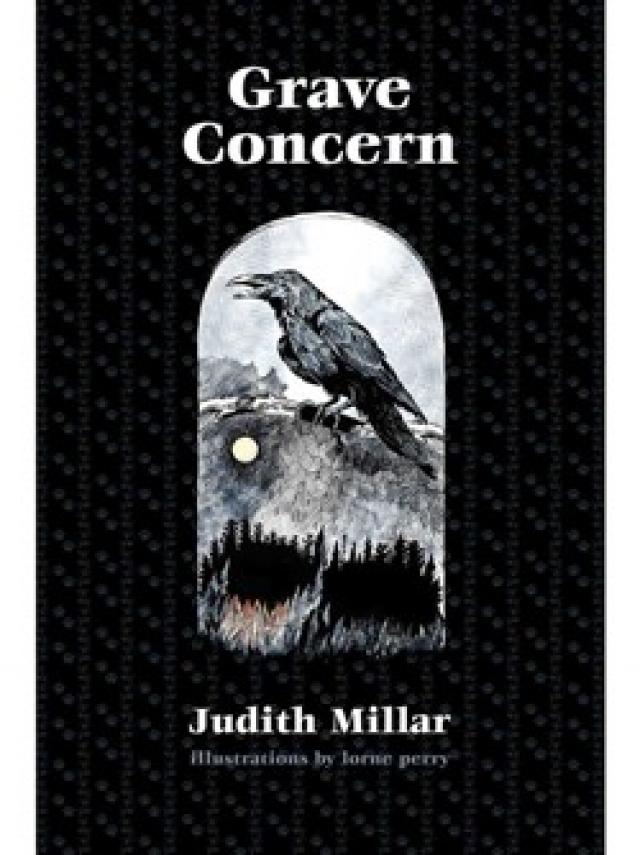
Grave concern, p.1
Grave Concern, page 1


GENERAL STORE PUBLISHING HOUSE
499 O’Brien Road, Box 415
Renfrew, Ontario, Canada K7V 4A6
Telephone 1.613.432.7697 or 1.800.465.6072
www.gsph.com
ISBN 978-1-77123-933-2
Copyright © Judith Millar 2012
No part of this book may be reproduced, stored in a retrieval system,
or transmitted in any form or by any means without
the prior written permission of the publisher or,
in case of photocopying or other reprographic copying, a licence
from Access Copyright (Canadian Copyright Licensing Agency),
1 Yonge Street, Suite 1900, Toronto, Ontario, M5E 1E5.
Cover art and illustrations: Lorne Perry
Design and formatting: Magdalene Carson.
Published in Canada.
Cataloguing data available from Library and Archives Canada.
Contents
Title Page
Copyright
Contents
Dedication
Acknowledgements
Epigraph
Prologue
1 The Kiss
2 The Party
3 The Grave
4 The Prize
5 The Sign
6 The Visit
7 The Fire
8 The Ring
Epilogue
About the Author
To the memory of
Ruth and Charles (Chas)
ignis internum
I would like to thank my late parents for the courage and adventurous spirit that brought two city folk to a fledgling town in the backwoods and thus allowed me to grow up in a full-on embrace. Also my deep thanks to a true wise woman, Cathy Higgins (Cranbrook Cathy), whose friendship, stories, laughter, encouragement, and support of women artists was a mighty inspiration.
Thanks to everyone at GSPH for their good advice and energetic discharge of the book-publishing task at a time of industry upheaval and change.
Much gratitude for their insight and valuable suggestions to writing comrades and readers of the early drafts — Marion Harrison, Elizabeth Haynes, Susan Millar, and Laureen Rama.
To Lorne Perry, illustrator, bounteous bouquets for his enthusiastic and entertaining indulgence of a perceptually challenged author’s odd whims and flights of fancy.
To my ever-patient and supportive family, including, but not limited to, Rick, Emma, Kip, Susan, and Carol: “Thy firmness makes my circle just/ And makes me end where I begun.”
One brings Sorrow
Two bring Joy
Three a Girl
And Four a Boy
Five bring Want
And Six bring Gold
Seven bring secrets never told
Eight bring wishing
Nine bring kissing
Ten, the love my own heart’s missing!
– The Magpie Rhyme (traditional)
Prologue
Raw-Raw cocked her head and snatched the fine gold circlet topped with diamonds and emeralds. Rose up with the precious Shiny in her bill, heading for her secret stash. Then came the Fear, that sick, familiar smell of death and loss. Raw-Raw deposited the Shiny and hunkered there a while. Growing restless, she stretched her wings and flew off, legs flopping like black ribbons in the breeze.
From high above the smelly smoky billows, Raw-Raw scanned the place by the highway. HO-TELL, Jaypee’s roost, was invisible, concealed below the choking ash. Bank and soar. Bank and soar. Around and around. Feathers rustling on the heat like mourning silk. No use. Jaypee’s roost was hidden, maybe gone, just like long ago in the Deep Wood when Raw-Raw lost her Old Ones and siblings. The scorching heat, the roiling fog, the deathly stench. Young Raw-Raw left all alone.
1
The Kiss
Kate sat in Grave Concern, under the rhythmic ticking of the fifty-year-old wall clock. She was supposed to be designing a dignified card to be left in the foyers of churches up and down the valley, advertising her grave-tending service to the recently bereaved. She was working with her company tag-line, for thus friends absent speak, quoted from John Donne. The words skittered through her head in varying order, shifting places at random like the Mad Hatter’s party guests. Now her fingers fell off the keyboard, and her eyelids drooped nearly shut.
Kate’s friend Mary O’Beirne blew in the door, plunked herself on a chair, and settled her boots on Kate’s desk. “Kate, Kate, what’s with the long face?”
“Mary, hi. Not much. I dunno. Sleep’s eluding me these days.”
“Really.” Mary’s large, grey eyes studied Kate. In a familiar gesture, Mary flipped her long black “straight-as-the-bleepin’-Virgin” hair behind an ear. “Well, girl, you’re in luck. Just came from the post office. Christmas package from my dad, the old pump sucker. Here’s what you need.” Mary’s feet vanished as she reached into her bag on the floor. In their place appeared a bottle of screech. “Ever since promising me mum — God rest her soul — he’d get off the stuff, Dad’s after sending it to me. Says he can’t pass up a bottle when it comes his way. So, Merry Christmas, dear. Got a glass?”
Kate proferred her coffee mug. “There’s another one back there somewhere,” she offered weakly, and Mary went scrounging in the backroom.
Mary returned with the second mug and poured them both a generous drink. “I’d say this is just what the doctor ordered, wouldn’t you?”
Kate had to laugh. Mary was in fact a doctor, had moved to town six years ago as a result of the town council’s last big physician recruitment push. Six years Mary had been here, still a newbie in Pine Rapids terms.
“So what’s your excuse, Mary?” Kate nodded at Mary’s glass. “You’re not on call or anything? I wouldn’t want to be an accessory to malpractice — or murder.”
“Day off, thank Jeezus,” Mary said. “Ever since that goddamn dog got clobbered up Wycliffe way, she just hasn’t stopped.”
“Someone clobbered a dog?”
“Aw, Mayor Hinks came hurtling along just as Madge Fitzgerald called her dog in from the field across. Too bad. Unfortunately, the SUV failed to finish it off completely, so someone thought of knocking on my door to do the honours. Since I’m nearby, I guess. Lucky I had my bag home. Shot it up with a shitload of Demerol. Not much else to do, I’m afraid.”
Mary raised her glass and took another long pull. “And since then, it seems like everyone and their dog, so to speak, has had some emergency or other. Jeezus, it hasn’t stopped all week. Babies, burst appendix, even a shooting, for God’s sake.”
Kate’s eyebrows shot up. “A shooting?”
“Aw, just old Buck Miller after shootin’ himself in the foot, cleaning his gun.”
“Anyone died lately?” asked Kate.
“ ’Fraid not, dear. Not that I know about, anyway. I guess you and I are kind of at cross purposes that way, eh?” Mary snorted and poured some more screech in Kate’s glass, despite the fact Kate had so far taken but a single sip. “Don’t worry. I expect the dying’ll pick up after Christmas. So what’s this about not sleepin’, girl? Jeezus, just give me a bed and I’d sleep till next November. Something on your mind?”
“Well, I don’t know how to put it, exactly. Promise you won’t have me committed.”
“Can’t promise,” said Mary gravely. Then hooted with laughter and banged her fist so that Kate’s desk wobbled. “Okay, okay, I promise.”
“Well, I was up at the graveyard today, working.”
Mary took another swig from her glass, and motioned for Kate to do the same, which Kate did. Whoa.
“I’d just got the flowers all arranged and stood up.”
“Dizzy, lightheaded. Nothing to stress about. Happens at our age,” Mary said.
“That’s not what I’m talking about, Mary,” said Kate. And she laid out for Mary the scene playing over and over in her mind: It had been about five o’clock. Already dark, Kate had been thinking, and not winter yet. You had to love this country. She’d gathered her things quickly and made for the car, glad to leave the graveyard to the chill November dusk. She’d opened the trunk and tossed in plastic bags and wrap, ribbon and scissors, polishing cloths. Banged down the lid and walked to the driver’s side, slipping the camera strap from her neck. Just then, as the strap slid free, her eye caught a streak of movement, on the north side where the footpath ran along the fence. Her heart, like the used Impala, revving way too high.
Mary frowned and swished back another mouthful. “Go on.”
“Could have been a dog, I guess, running loose from a nearby farm. The truth is, Mary, I can tell myself that all I want, but it wasn’t a dog. No way. I — I just don’t know what the hell it was. Scared the shit out of me. Days I go along all right. But nights when I’m dropping off to sleep, it comes back again. Then I’m awake for hours.”
“What comes back — the vision? We’ve got drugs for that.”
“No, the memory. And it freaks me out, Mare. It’s worse than a vision. If I kept seeing the vision, I’d know it was just me seeing things, for some perfectly explainable reason, like I was finally cracking up. But remembering, I know it was IT, not me. See what I’m saying?”
Mary put her cup down. “Wolf, maybe?”
“Bigger. And besides, wolves haven’t been anywhere near town for years. And not a deer, or a moose. It wasn’t like that, at all.”
“Dark? Dusk? Eyes playing tricks with the trees? Could it have been the camera strap, dear, in your peripheral vision?”
Kate’s disdainful expression clearly put that last suggestion in its place. “Okay, it was dusk, Mare, I’ll give you that. But I know what I saw, no question.”
“You hadn’t been — y’know,” Mary nodded at the bottle from which they were drinking.
“C’mon, Mary. Me? At work?”
“Bigger than a wolf, you’re saying.”
“That’s what I’m saying.”
“Jeezus,” was all Mary said.
A week later, Kate stood in line for the ATM, staring absently in the window. The bank calendar read DECEMBER 8. Which meant DECEMBER 7 had come and gone. Which meant — Kate groaned — her most loyal customer, the very rock on which Kate’s wobbly new life stood, had been let down. Disappointed. By Kate. By Kate’s business, purveyor of solace to a disappointed world. Ordinarily, such a slip would not upset Kate unduly. But Adele Niedmeyer was no ordinary customer. The ninety-two-year-old had staked her claim on Kate’s particular affection by placing the very first call to Grave Concern just over a year ago.
Before Adele’s call, Kate imagined potential clients much like her former self: boomers living far away from the parental home, urbane and harried, with a habit of seeking experts for such life-conundra as dog-walking and clothes closet consultation. These folks, reasoned Kate, possessed the requisite guilt — and wealth — to support a grave-tending business. By contrast, Adele (bless her congenitally enlarged heart) had tended her late husband’s grave devotedly — until her adult children drove the dear old thing from her comfortable home of fifty years and into the ghoulish arms of Morning Manor Rest Home for the Aged. Undaunted, from that institution half an hour along the highway, had Adele put arthritic forefinger to touch-tone, enlisting Kate’s assistance for her late husband Nathan’s plot.
Moved by Adele’s plight, Kate had given her very first customer a lifelong deep discount. No regrets there. But now Kate had a strong desire to kick herself. Here it was, DECEMBER 8, ninety-two years plus a day since little Nathan Niedmeyer had stumbled on the Austro-Hungarian scene, and (having died conveniently on his birthday) three years plus a day since Nathan’s final bow here in Pine Rapids, Ontario, Canada. And what had Kate Smithers, president and CEO of Grave Concern Inc., done for Mr. Niedmeyer? Nothing. Nada. She’d missed the crucial date, and Grave Concern Inc. had failed to live up to its mission statement, which explicitly included the words “prompt” and “timely.”
Kate rushed through her bank business and hurried up the street to Flower Power, the floral shop that employed her as a delivery person — on a basis described as “casual” by the owner, Gwyneth Waters, and “rare” by Kate herself. As Kate burst through the tinkling door, Gwyneth’s face told Kate exactly where she stood: about a step from the firing line.
Gwyneth was known for her temper. So known was Gwyneth Waters for her temper that, five years ago now, she had been forced to find alternate employment after failing to persuade the current school board of the efficacy of her corporal disciplinary methods, tried and true for four decades.
Today, just as in Grade 9 Math, Kate easily read Miss Waters’s mind in Miss Waters’s face. “Sorry, Mi — Gwyneth, I got hung up at the bank.”
Moving quickly, Kate swooped in and gathered up three huge bouquets from the desk. “Christmas orders sure are coming in early this year, eh?”
“No. Christmas bouquets always start about now, Kate. But, as you are new here, on probation I might add, you wouldn’t know that.”
“Right,” said Kate, and swept out the door in a mass of foliage. Bitch.
Kate manhandled the sticky back door of the Impala (having learned the hard way not to use the cold trunk) and plopped the bouquets in. She checked the addresses on the delivery docket. Two along the highway, one in town. It was now three o’clock. Could she finish the deliveries, put together materials for Nathan Niedmeyer’s grave, drive to the graveyard, fix up Nathan’s plot, take Before and After photos, and email them to Adele at Morning Manor, all before Hank Dixon’s 5:30 appointment back at Grave Concern? It was definitely going to be tight.
As she waited at the town’s single traffic light — not strictly speaking in town but on the highway leading out — Kate drummed her fingers impatiently on the wheel. She glanced in the rear-view mirror. Same old crow’s feet, wide brow, hazel eyes. Prominent cheekbones — unfortunately not so much Meryl Streep as Olduvai Gorge … ous — ha! Kate had noticed it took more effort these days to imagine her features as a pleasing whole. When she was a little girl, Monsieur Marcotte at the antique shop would let her hold the old wooden stereoscope to her eyes while he placed the cards in the slot. Like magic, the blurry double photos would resolve into a delightful single image. Kate reconsidered her face now. Singular, perhaps, but as yet unresolved.
Kate swore under her breath at the light, and then at its maker, and then at his mother. At last, realizing how far gone she was, Kate sighed. She wondered whether this new life was really such an improvement over the one she’d ditched out West.
Out West. Those days, the phrase was like a mantra in the wind. Out West. Work was said to be plentiful and was. Kate found herself in the common graveyard of Arts majors: something now called communications but then known as PR. Public relations. But she wasn’t cut out for PR, not at all. For one thing, she was shy with strangers. She hated large groups and crowds. Crowds of strangers: the worst. Setting up news conferences, chivvying media, speaking with forked tongue — it was all wearing. As for her employers’ public image, for the most part Kate could not have cared less.
Romantically, Kate’s philosophy turned on liaisons rather than serious affairs: how could she tie herself to a place where winter was not only endless but palpably malevolent? A blizzard-wracked plain that kept trying, like a fly-tormented horse, to sweep her from its backside? Witness the annual siege: the months of November, December, and January, better known (by Kate) as Chapped Lips, Sinusitis, and Influenza. Trapped in a cage of cold, assailed by long weeks of stark refrigeration under a merciless firmament, one’s sole source of hope was a massive cloud moving in on the western horizon, presaging the warm wind known as Chinook. After a day or two of its relief, though, came inevitable re-immersion in the deep freeze.
Kate found what solace she could in her bookshelf.
No man is an island, entire of itself; every man is a piece of the continent, a part of the main …
Come February, the longer and relatively warmer days saw her stir like a bear from hibernation — she might look into jazzercize or accompany her straight (and happily married) friend Gladys, whose old-fashioned name and impeccable manners belied a pulsating rage at convention, to the one lesbian bar in town. Just (as Gladys demurely put it) “for the heck of it.”
Thus, by various mental tricks and devices, Kate would arrive at what she’d dubbed Mingy March. Harrowed by the foreknowledge of April’s certain snows, Kate would book the cheapest package deal she could find to somewhere warm. There, cloaking meatier fare behind Danielle Steel (so as not to attract undue attention), Kate would retreat to plastic loungers by interchangeable blue pools to devour more Eliot or Donne:
If a clod be washed away by the sea, Europe is the less, as well as if a promontory were, as well as if a manor of thy friend’s or of thine own were. Any man’s death diminishes me because I am involved in mankind, and therefore never send to know for whom the bell tolls …
It tolls for thee. With the perspective of distance from the icebound city, Kate yearned still more to bid it adieu — the bland, grey pavements, the soul-sucking aridity, the abysmal architecture. Not to mention the prospect of Maddening May, when the same long weekend that would see her eastern comrades easing down in a lawn chair with a beer by the lake would see Kate’s odds of waking up to snowfall hardly less than in previous months.









