

Organ meats, p.1
Organ Meats, page 1


Copyright © 2023 by K-Ming Chang
All rights reserved.
Published in the United States by One World, an imprint of Random House, a division of Penguin Random House LLC, New York.
One World and colophon are registered trademarks of Penguin Random House LLC.
Library of Congress Cataloging-in-Publication Data
Names: Chang, K-Ming, author.
Title: Organ meats : a novel / by K-Ming Chang.
Description: First Edition. | New York : One World, [2023]
Identifiers: LCCN 2023015607 (print) | LCCN 2023015608 (ebook) | ISBN 9780593447345 (paperback) | ISBN 9780593447352 (ebook)
Subjects: LCGFT: Fantasy fiction. | Novels.
Classification: LCC PS3603.H35733 O74 2023 (print) | LCC PS3603.H35733 (ebook) | DDC 813/.6—dc23/eng/20230403
LC record available at https://lccn.loc.gov/2023015607
LC ebook record available at https://lccn.loc.gov/2023015608
Ebook ISBN 9780593447352
oneworldlit.com
randomhousebooks.com
Book design by Susan Turner, adapted for ebook
Cover design: Michael Morris
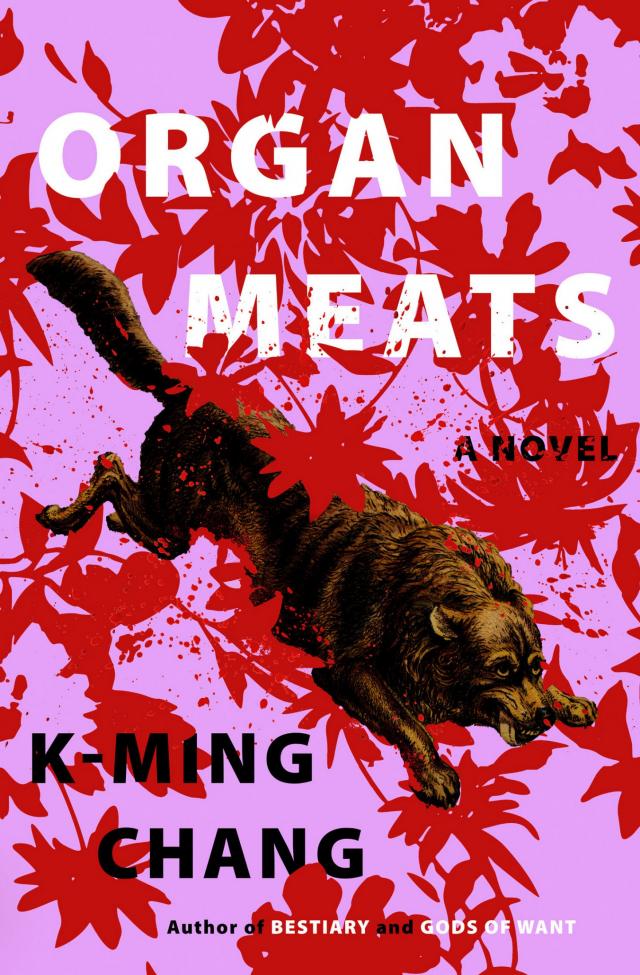
Cover images: Private Collection © Look and Learn/Bridgeman Images (dog); Galina Kamenskaya/Getty Images (flora); Candy Nguyen/500px/Getty Images, Vizerskaya/Getty Images (splatters); nycshooter/Getty Images (spine)
ep_prh_6.1_145164751_c0_r0
Contents
Cover
Title Page
Copyright
Epigraph
Disparate Girls Discover that Doghood Is Not the Opposite of Godhood, and Anita Hsia Recounts the Ox-Boned Origin of Her Family Residence
When Wives Were Dogs
Rainie Tsai Learns to Suspend Her Disbelief, Which Is Impressive, Given the Immense Weight of It, and Anita Hsia Presents Her Skeletal Assumptions
A Dialogue Between Two Daughters
Anita Senses an Impending Severance
The Neighborhood Bitches (Bitches, Both Figurative and Literal) Narrate What Is Troubling Them, and Bunk Beds Are Ripe for Intimacy and Trickery
The Beginning of Anita Hsia’s Unsupervised Excursions into Dreaming
Rainie Rears Against Red Thread and Unwillingly Attends a Q&A with the Strays
Anita Recounts Strange Occurrences in the Week Before Rainie Leaves Her Destined Love, and Dreams Fail to Manifest an Appropriate Stone
Anita Encounters a Dog of Dubious Origin, and Rainie Enters a Viscous Slumber
The Dream that Rainie Forgot (and Will Someday Soon Remember)
Anita Delivers a Fossilized Apology
Correspondence Between Our Organs
The Hsia Family Tampers with the Red Thread of Fate, and Anita Gives Cunnilingus to a Tree, Not Unwilling
An Abbreviated List of All the Ways the Hsia Family Attempts to Revive Anita
Anita Meets the First of Her Many Mothers, and the Sycamore Tree Provides a Spiritual Dwelling
What Happens While Anita Is Asleep (Having Wandered from Her Body)
Rainie Tsai Discovers that Dendrology Is Not Dentistry, and a Branch Is Returned to Her, in Living Condition
The Hsia Family Receives a Long-Loved Visitor, and Rainie Witnesses the Slow Rotting of Her Fated Love
The History of Our Intestines: A Juvenile Attempt at Poetry that I Will Deeply Regret in Coming Years, from Yours Truly (Truly Truly)
Rainie Seeks Out New Intestines
The History of Our Hair
Rainie Seeks Out the Reviving Properties of Red Thread
The History of Our Hearts
Rainie Makes a Stone of Anita’s Heart
The History of Our Bellies
Rainie Stomachs the Sky
Vivian Recounts the Building of Anita’s New Body, with Minor Digressions, and the Rest of the Hsia Family (and Rainie, and a Ghostly Pack of Ancient, All-Knowing Dogs) Witness an Awakening
Final Testimony of the Dogs as They Run on the Underside of the Pavement (As Read by the Soles of Rainie's Feet)
Acknowledgments
By K-Ming Chang
About the Author
_145164751_
“I had been taught by my mother to take my dreams seriously. My dreams were not unreal representations of something real; my dreams were a part of, and the same as, my real life.”
—Jamaica Kincaid, Annie John
“ ‘How did all this begin? And where are the souls to be reborn?’ ”
—Cao Xueqin, The Story of the Stone
Disparate Girls Discover that Doghood Is Not the Opposite of Godhood, and Anita Hsia Recounts the Ox-Boned Origin of Her Family Residence
In the center of summer, soft with rot, Rainie and I decide to be dogs. Cousin Vivian says you can’t be a dogpack with only two dogs, Rainie and me, but I say she forgot to count our shadows, Rainie and me plus two shadows, which makes four dogs, which is a lot of dogs. The dogs we know are strays, and they always travel in pairs or in sixes, and they sometimes get hit by cars and crows pluck the meat from their bones, though mostly they leave the bodies of the dogs alone, because there isn’t much meat on them. I decide that being a dog requires three main things: First, that we drink with our tongues, which is easy, because I drink out of bowls anyway, ever since Abu decided to grow flowers in all our glasses. The second thing is that we must have collars, because we are not strays. We belong to each other. We cannot be strays, because our ribs are not visible, mostly because we wear shirts. And we have names, mostly because we have mothers. Also, strays stink and have fleas, and we are required to bathe, though one time Rainie got bedbugs and she and her brothers wore rashes as long as capes down their backs and then Vivian and I got them too and Abu burned our sheets, bleached the carpeting. I halo Rainie’s neck with red thread from Abu’s sewing kit and make a knot where she swallows, then tie a symmetrical thread around my neck.
Now we’re collared together, I say. I get the knot right only on the second try: The first time, Rainie’s neck turns to steam, and I can’t get the thread to grip anything. There is something in her that resists it, that doesn’t want to bind herself to me. She lives by flitting. Even when she stands on the wrinkled pavement in front of me, she shifts from foot to foot like she’s surfing something, turning the street into a sea she’ll ride away from me. Rainie tugs at the thread, tries to wedge a thumb between the knot and her skin, but I tell her it has to fit us snug as a bloodline or else we can’t be synonyms.
The third thing is that we must learn to bite, even though our teeth are crooked and easily uprooted. We practice biting our own arms first, leaving purple perforated circles, and then we move on to biting shoulders, which requires our jaws to unhinge wider. I bit my cousin Vivian while she slept, kneeling in front of her mattress and gouging my teeth into her shoulder and gnawing the sphere of meat, imagining that Rainie had called me to fetch it, to bring it back to her whole, a tennis ball of bone, except we do not answer to names. When I bit her, Vivian flopped like a fish and landed outside her dreams, gasping, and I had to return her blood in a bottle. Rainie and I practice stretching our jaws, widening them enough for a crow to fly in and roost, and when our mothers see us sitting on the sofa, gaping at nothing, drool draping our chins, they leap at us and ask if we’ve become melon-headed.
When Rainie and I feel that we have properly committed to our new species, we walk the streets as a dogpack, our shadows tailing us. When our knees are sore and bleeding and gravel-crusted from crawling, we decide that we will be two-legged dogs. We sit in the shade of a bald sycamore tree, its trunk like a drunk woman hooked over the fence of an abandoned lot, and in the corner of the lot are dogs sleeping in knots, panting loud in the heat, tongues chugging like conveyor belts. We bark at them, whine, but they don’t recognize us, probably because we wear collars made of red thread, which mean we own our blood and they do not. When we lean on the fence, they leap up and foam white at the mouth, frolicking in their own snow. But they never come close enough for us to know. Rainie thinks the empty lot is full of dumped Styrofoam and exploding sofa stuffing and chunks of the moon’s infected flesh, but I know all that whiteness is the cream of their dreams. I want to enter their shoreless sleep, to paddle alongside their tongues, but Rainie and I haven’t yet convinced them that we are dogs too, and so they only watch us through the fence with eyes dark as doorways, their minds shining through like lamplight.
* * *
—
On the way home, we see two dogs on the street, one on top of the other, the one on top driving itself into the one on the bottom, and both of us stop, both of us watch. The dog on the bottom keeps trying to run away, its teeth barging out of its mouth. We have never seen anything move that way, the dog clambering on top, the hilt of its hips. It’s Rainie who tugs me away and says, Let’s go home, quick, let’s go, as if the dogs have caught us, as if we are the ones being watched.
The next day, when I knock on the door of Rainie’s unit, she answers with her red-thread collar on, her neck owned and boneless. Let’s be dogs, I say. Let’s go back to the sycamore that leans over the lot and let’s chew the leaves till our tongues dew with blood. But Rainie says no. I know she’s still thinki
On the way to the lot, the sidewalk bucks beneath our feet, meeting our steps midair, high-fiving our heels. I say the sidewalk is a skin, and trees are born out of it, roots pecking for air. But Rainie says no, it’s the heat that causes the concrete to grasp at the cool of our bodies. We don’t agree. One time, Rainie claims, she was riding a bus with her mother and she looked out the window and saw a big truck with a wasp’s ass churning the bodies of gray slugs and pouring the jelly onto the street. That’s what the sidewalk is made of, she says, while tripping on a crack as wide as a casket. Ahead, past the rows of duplexes and fourplexes jostling one another, the sycamore hooks a skeletal finger at us, beckons our breath, reels it out of our lungs. It’s so hot that the street has dissolved into tea and tries to shore at our feet, so we leap. That’s a lie, I say. It’s skin, not street. It winces if you lick it, though we can’t lick it now or our tongues will be grilled well done. And it’s called a sidewalk, I say, because you’re supposed to scuttle sideways across it like a crab. It’s not designed for our species. I hook my arm through Rainie’s and turn us sideways and shuffle us all the way to the lot, our ankles clanking like bells, our hipbones magnetizing in the heat.
Rainie says, Stop it, quit ringing me, and when we reach the fence, she unlinks from me and shoves me away. She says it’s not fair that I always get to invent the rules of doghood and she has to sniff after me. Fine, I say, you get to add a rule, but it has to be about wearing ourselves bare. We will be skin-only, and no one at school will make fun of us for wearing matching horizontally striped shirts our mothers sewed for us that make us look like Ronald McDonald and are too tight at the armpits and rip when we raise our hands. We will achieve the freedom of another being. I summon up a fist of spit, frothing at the mouth.
Foaming is not the freedom of another being, Rainie says. That’s rabies. She steps away from the fence and toward the shadow of the sycamore. If we have rabies, she says, who’s going to give us dinner? Rainie only believes what she can eat. Her mother says she has to be fed every day at the same time or else she will swallow her shadow and skin herself. Already, Rainie is scraping bark from the sycamore tree. While her mouth is dissolving the sycamore’s scalp, I squat among the roots and tickle the sidewalk with a stick. It shivers and nips off the tip. Fine, I say, then what’s your rule? Being part of this dogpack is a lot of work, and you have to do your share. There is one dog tightening the screws of its teeth in the far end of the lot, its head the color of crusted blood, and its job is to pee on the sycamore and fertilize the lot in all four corners. At least it’s trying to contribute.
I’m trying to contribute, Rainie says, spitting out bark. But you keep interrupting. She squats with me between two roots and says she’s thinking. For Rainie, thinking and eating are synced activities, and her molars are gritting like the gears of her mind. When she’s finished sipping up a ribbon of bark as long as our arms, she stands and gestures at the rusted fence, says she’s decided. The red thread around her neck is glowing, and I know she’s going to test me. Try, I say. Whatever you’ve invented is already inside me.
My rule, Rainie says, her head turned toward the fence, is that you have to poop in the lot like they do.
I swallow all the foam in my maw and walk up to the fence. In the holes of it, dogs are curled in sleep. Some of them are missing ears, and someone has been sewing for them: The blood-colored dog is closest to the fence, and its right ear is a sycamore leaf stitched to its skull with red thread. The other is a lobe of Spam. Ten feet from me, the dog is humming static in its sleep like a radio. If I climb the hot fence and crawl into the lot, the red one will wake, so instead I eye the diamond-shaped peepholes and identify the one that aligns with my intentions.
Quiet as I can, I turn around and grill my back on the fence. I shimmy down the jeans my mother sewed belt loops onto, even though I won’t wear a belt unless it’s red thread, unless it’s a fate I can wear around my waist. When the jeans puddle around my ankles, I bend forward and jut out my hips. Rainie runs forward, mouth pursed with a warning, but I shuffle back and push out a slug of shit, threading it through the hole in the fence, making a mouth of it. It dangles on the other side, wriggling like a flooded-out earthworm. The redheaded stray must be a beacon, because it wakes and rings its teeth in alarm. I hear the dirt dance as the dog bounds up to the fence and barks, the other strays waking behind it, howling. Rainie grabs my shoulders and yanks me away from the fence as the red dog charges. This is how Rainie describes it: the red dog surging, piloting its teeth, leaping up and snipping the strand of shit from my ass. Like a soft-serve machine, Rainie says. The dog cut it off perfectly! In a past life, I tell her, the dog must have been ice cream.
In my time: I collapse on top of her as the red dog batters the fence, shoving its snout through the hole. It tosses the shit onto the soil and stamps on it like a snake, snapping at its prey. On top of Rainie, I slot my face into the space between her neck and her shoulder, nosing the flap of her earlobe. Whisper that I did it. Rainie laughs and I laugh too, releasing a fart that will flavor a neighboring city. Her laugh is brittle as bark, flaking fear. Can you believe it, I say, leaping up and pulling her under the sycamore. That red-faced stray saw my insides. It looked all the way inside me, the way we look at the sun through a bendy straw and expel it like a spitball. It probably saw all my organs juggling themselves, all my blood a big ball of yarn. Shaking her head, Rainie says we’ll never see inside anybody, roadkill not included, but her voice is vapor to me.
Your turn, I say to Rainie. Behind us, the strays sheathe their legs again, tethering themselves to sleep, except the red one who saw inside me. It flickers between being red-faced, red-snouted, red-headed, and red-bodied: the different stages of tunneling through a body. It can’t decide how stained it should be, how clean. Pawing at the remains of my waste, it flattens my poop into a patty and then a field, spreads it like a warm sheet on a bed. It must be lonely being the only rusted dog. Curling on my mattress of mud, it tucks its snout under its tail. You know me, I say. You put on your blood like a dress, just like I do. I show the dog my red-thread collar, and I know its veins run in the same circle.
Rainie watches me. It’s my turn to test her. Her shirt is swamped, cleaving so closely to her spine that I can see the exact curve of it, like a silver spoon cuddling my tongue. Her chest cresting with breath.
Another rule is only fair, I say, yanking on the red thread around my neck. I risked my asshole for you! Rainie swallows, her thread thrumming a nervous note.
Let’s be dogs the real way, I say. The final rule is that we will try what those two dogs were doing yesterday on the street. Hip to hip. We will be real dogs and we will give birth to puppies, litters of them, and we will get to keep them all and feed them the livers of liars.
Rainie sits down to think about it, her back resting against the trunk of the sycamore. She rakes her nails down the trunk, the bark glittered with ants. Its roots are exposed like bone, and I wonder who stole the skin off them. Okay, she says, and asks which dog I want to be. I say I want to be the dog on top and she can be the one on the bottom. Rainie looks down at her lap, the crotch of her pants mended so many times that the seams bulge with teeth. I remember when she used to itch her crotch in public during that summer of the bedbugs, her fingernails grated down to nubs. Out of sympathy, I scratched myself too, even though I didn’t have any bites, clawing myself until I couldn’t sleep and lay awake every night, stinging and thinking of our paired misery. I miss that summer of synchronized scarring. I miss the brazen way she used to flay herself for me.






