

Negative space, p.1
Negative Space, page 1
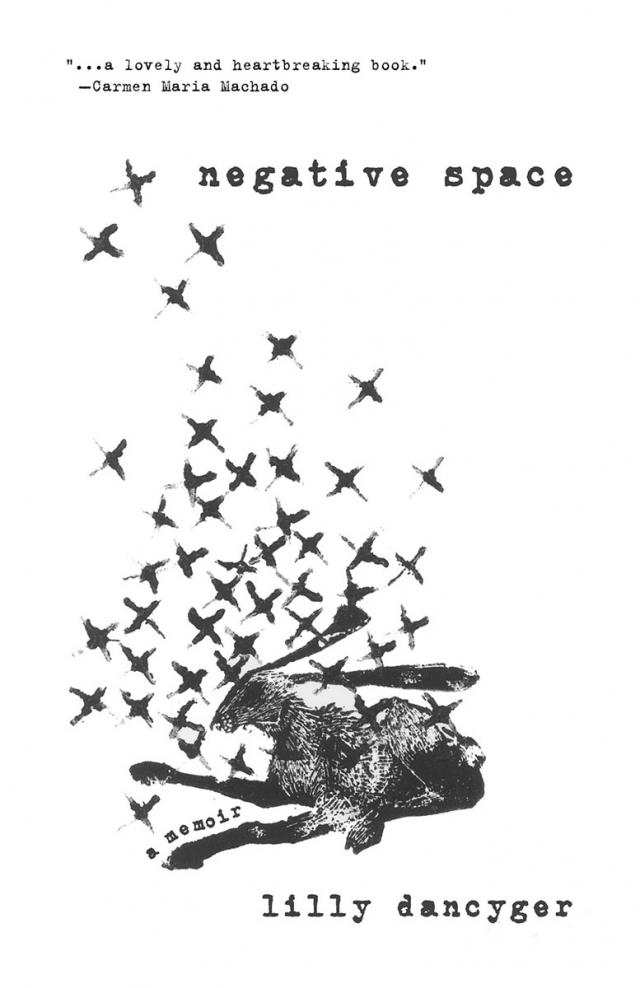


PRAISE FOR Negative Space
“Using images and text, Negative Space shows us the New York art scene of the 1980’s and the author’s late father—but neither are ghosts here. They are written with full splendor, tenderness, and possibility. Exploring her artistic legacy, Dancyger confronts what it means to create and build meaning from absence. Candid, thrilling, wickedly smart, Negative Space is one of the greatest memoirs of this, or any, time.”
—T Kira Madden, author of Long Live the Tribe of Fatherless Girls
Negative Space is a lovely and heartbreaking book; navigating pain, inheritance, and loss. Dancyger’s father emerges from these pages as vividly as if I’d known him.
—Carmen Maria Machado, author of In the Dream House
“This book is so many things: a daughter’s heartrending tribute, a love story riddled by addiction, a mystery whose solution lies at the intersection of art and memory. Together, they form a chorus that I could not turn away from, and didn’t wish to. Like all great works, like those of the author’s father, this book resists description but articulates something profound—about grief, art, and love—that could not have been communicated in any other way.”
—Melissa Febos, author of Whip Smart and Abandon Me
“Lilly Dancyger creates an unflinching account of her artist father’s snakebitten life and his struggles with addiction – peeling back the layers around an artistic practice that seems weighted with vulnerability. Ultimately, he comes painfully alive as Dancyger charts an elegiac path to her own self-discovery.”
—Cynthia Carr, author of Fire in the Belly:
The Life and Times of David Wojnarowicz
Negative Space is a brilliant, moving, unique, thought-provoking meditation on the artistic life, fathers and daughters, and the struggle to live life at the highest pitch in each generation. This is a rare book about art, and one to treasure.
—Mark Greif, author of Against Everything
“This fierce, intimate work explores the ways in which we construct identities for the people with whom we’re closest, and how we must eventually look beyond those constructs in order to see the world the way it really is…”
—Refinery 29, Most Anticipated Books of 2021 List
“Dancyger dives deeply into the liminal space of grief and loss in order to re-collect traces of her father as well as pieces of self. As she travels the past picking up remnants and clues from her father’s art and life, Lilly brings to form new stories of family and identity as their own works of art. Negative Space is a beautiful restoration act that brings her own art and heart to life.”
—Lidia Yuknavitch, author of The Chronology of Water
“In Negative Space, Dancyger achieves that beautiful, often elusive, balance of writing about addiction with equal parts examination and empathy. Unraveling the missing facts about her father’s life, addiction, and death, through memory, investigation, and his art, she writes with an eye to understanding that we are all more than one “thing,” that parents are humans first and parents second, that people in the throes of addiction are multi-dimensional. As someone who struggled with heroin addiction for many years, as her father did, the care with which she told this story is exquisite. At turns heartbreaking, reflective, and light, I tore through this book and, when I was done, found myself returning to pages I had marked, passages I had underlined, because the story unfolds in layers, just like life does.”
—Erin Khar, author of Strung Out:
One Last Hit and Other Lies that Nearly Killed Me
“Negative Space is made of a daughter’s love, a detective’s quest, and a true wordsmith’s gift of beautiful prose. Dancyger pursues the clues left behind by her father in the provocative, often disturbing artwork he made, clues not only to his mind but to the central mysteries of her life. Her story itself becomes provocative, harrowing--and deeply moving. This book is a true accomplishment, one that often left me stunned and disturbed in all the right ways, all the ways brilliant art does. In writing about her artist father, Dancyger has herself created a work of art.”
—Alex Marzano-Lesnevich, author of The Fact of a Body
“Dancyger’s memoir is a page turner, the details in this book stayed with me, I dare you to put it down.”
—Sofia Perpetua, journalist, goodreads.com
Copyright © Lilly Dancyger 2021
All rights reserved. No part of this book may be reproduced or transmitted in any form or by any means electronic or mechanical including photocopying recording or any information storage and retrieval system without permission in writing from the Publisher.
Library of Congress Cataloging-in-Publication Data
Names: Dancyger, Lilly, author.
Title: Negative space / Lilly Dancyger.
Description: Santa Fe : Santa Fe Writers Project, 2021. | Summary: “Despite her parents’ struggles with addiction, Lilly Dancyger always thought of her childhood as a happy one. But what happens when a journalist interrogates her own rosy memories to reveal the instability around the edges? Dancyger’s father, Joe Schactman, was part of the iconic 1980s East Village art scene. He created provocative sculptures out of found materials like animal bones, human hair, and broken glass, and brought his young daughter into his gritty, iconoclastic world. She idolized him-despite the escalating heroin addiction that sometimes overshadowed his creative passion. When Schactman died suddenly, just as Dancyger was entering adolescence, she went into her own self-destructive spiral, raging against a world that had taken her father away. As an adult, Dancyger began to question the mythology she’d created about her father-the brilliant artist, struck down in his prime. Using his sculptures, paintings, and prints as a guide, Dancyger sought out the characters from his world who could help her decode the language of her father’s work to find the truth of who he really was. A memoir from the editor of Burn It Down: Women Writing About Anger, Negative Space explores Dancyger’s own anger, grief, and artistic inheritance as she sets out to illuminate the darkness her father hid from her, as well as her own”—Provided by publisher.
Identifiers: LCCN 2020027267 (print) | LCCN 2020027268 (ebook) | ISBN 9781951631031 (paperback) | ISBN 9781951631048 (ebook)
Subjects: LCSH: Dancyger, Lilly. | Adult children of drug addicts—United States—Biography. | Journalists—United States—Biography.
Classification: LCC HV5132 .D353 2021 (print) | LCC HV5132 (ebook) | DDC 362.29/14092 [B]—dc23
LC record available at https://lccn.loc.gov/2020027267
LC ebook record available at https://lccn.loc.gov/2020027268
Published by SFWP
369 Montezuma Ave. #350
Santa Fe, NM 87501
(505) 428-9045
www.sfwp.com
For my father, Joe Schactman.
And for everyone living with an absence.
Author’s Note
To write this book, I relied on my own memory where applicable—as well as my father’s notebooks and letters, my mother’s journals, and over two dozen interviews. The stories I collected through these interviews often contradicted each other, and sometimes themselves. I did my best to find something like the truth in the in-between spaces where all of these various sources overlapped.
For a long time, I struggled with the presumptiveness of telling someone else’s life story without their input—especially someone as proud and opinionated as my father. But the more I saw how rarely two people remembered the same event in the same way, the more I realized that even if I could have interviewed my father directly, I still wouldn’t have gotten “the truth,” whatever that even means. So this story is a truth—one of many.
Archival Note
All photographs of the artwork included here were taken by the author unless otherwise noted. Where locations are noted, pieces were photographed at the homes of friends and relatives who own them; where no location is noted, they are from the author’s personal collection. Because records are scarce and incomplete, most pieces are untitled, and materials listed are the author’s best guesses based on examination.
There’s a photograph of my father laughing on the last day I saw him alive. It’s in a two-part frame with a picture of me, also laughing, taken in the same moment. His hand is over his mouth, covered in nicks, cuts, and callouses from working with wood and concrete at his construction job and in his art studio. Our faces are both red from laughing until we were gasping for air.
I look at these photos and try to hear the sound. Sometimes I can remember his laugh, and sometimes when I try there’s just silence. I can’t remember what was so funny, either, but I remember how totally enraptured and entertained I was by him, and how proud to know that he felt the same about me.
It was Easter Sunday, 2000. I was eleven, almost twelve. I hadn’t seen my father in half a year, and we were living on opposite sides of the country. My mother had brought me to San Francisco to spend the weekend with him.
At the end of that Sunday, the three of us had dinner at a ’50s-style diner covered in chrome called Hamburger Mary’s, on Folsom Street. Sitting in the red vinyl banquet, I had a grilled cheese and a chocolate milkshake, which I drank as slowly as possible to extend our visit by just a few more minutes. We all talked and laughed together so comfortably that I imagined I might finally get the wish I’d been holding onto for four years: that my parents might remember that they loved each other, and get back together.
When my milkshake was gone and it was time to go, I cried and held onto fistfuls of my father’s shirt like I had when I first learned he wasn’t going to be living with us anymore. I dug my nails into the flannel and breathed in the stale cigarette smoke and the faintly chemical plaster smell. He hugged me and let me cry, waiting for me to get it all out. But when I didn’t stop, didn’t let go, he finally took my hands in his, leaned his face in close to mine, and said, “I’m sorry, sweetheart. I have to go. I love you.”
He wrote me a letter on his bus ride home. Starting with his signature self-deprecating humor, he wrote, “You somehow manage to look so much like my daughter (the Schactman family resemblance is very strong) + yet still you manage to be so beautiful.”
He implored me not to let adolescence shrink me. “Stand up and be proud,” he wrote, warning that young women sometimes hide their intelligence to avoid drawing attention to themselves. “Never be embarrassed by your ability to make just the right sentence, with all of the exact words you wanted and needed.”
He praised my vocabulary and articulate speech, and drew a comparison between language and his use of images as an artist, which would become even more valuable to me once I grew up and built a life around words: “The more closely you look at something, the more likely it is that you’ll be able to draw that something, and the more you draw, the better you see. Well, knowing how to use language accurately and well, and being able to take pleasure in it, means that your brain is always able to think more and more accurately and elegantly.”
And he apologized for how his heroin addiction had affected me. He never referred explicitly to drugs, but, euphemistically, to “the stuff I’ve been going through.” He’d recently been arrested and spent time in inpatient rehab; he could no longer hope I wouldn’t notice. But he still couched it in gentle terms—to protect me, or his dignity, I’m not sure.
By the time that letter arrived, he was dead. Those last words of fatherly praise and advice became as precious as Moses’ tablets; words from beyond, all there would ever be.
When my father died, I knew he was clean because he’d told me over the phone that he was healthy and doing really well, and I’d heard the lightness in his voice and known it was true. We’d made plans to camp under the redwoods in Northern California, and I knew his excitement wasn’t just about this visit we were planning, but about his new start, finally off drugs. I knew, but all of the adults seemed to know just as surely that he’d died of an overdose. I could hear them whispering when they thought I wasn’t paying attention, and I saw the way they looked at me, like I was about to get more bad news. I knew they thought I was in denial, that I couldn’t understand such adult things.
We had the funeral without proof either way, still waiting for the medical examiner’s report.
My father’s friend Audrey had everyone over a couple of days before the funeral, to be together and mourn and drink and talk. I didn’t like how everyone was looking at me, so I mostly hid in her bedroom, lying curled up like a cat on the pile of everyone’s coats on the bed. I came out at one point, and as I stepped into the living room, I heard someone say in a loud whisper, “I mean, it had to be an overdose, right?”
I was entering the room from behind them, and they hadn’t seen me yet. I very quietly sidled up to the couch, leaning in until my face was just a few inches from theirs and hissed, “It wasn’t.”
I’d hardly spoken at all in the first hazy days since his death, and my voice came out dry and brittle. Everyone in the room looked up, realizing what had happened, wondering if this was the moment my quiet shock would shatter into torrential, raging grief. They all stared at me, waiting.
I fled back into the bedroom to burrow into the pile of coats and cry, as much from anger as from grief. There was a collective sigh that said they still didn’t believe me.
The autopsy report came days or weeks later, confirming that there was no heroin in my father’s blood when he died. My mother clutched it in both hands as she said the words, “It wasn’t an overdose.” I collapsed, sobbing with both of my palms and my forehead pressed into the floor like a child’s pose in yoga, letting go of the weight of being the only one to defend him. Her breath was shaking as she pulled me up and into her arms, still holding the report tight in her fist, smudging it with her sweat and strain and relief. She’d been clean herself for four years by then, and I knew she wanted as badly as I did to believe that he hadn’t been taken down by the monster that had chased them both for so long. But she also knew better than I did how easily it could have come back for him, even after he thought he’d escaped it.
The coroner couldn’t determine a clear cause of death, which left us with so many questions—they said it seemed like he vomited while sleeping on his back and choked, but they couldn’t be sure enough to list that as the official cause. They tested each of his organs. They saved some of his tissue in case future tests became available that might tell us which switch flipped and made my father’s body stop living at 43 years old. My mother couldn’t stop speculating, and still does sometimes—wondering if he died of long-term lead poisoning from using the toxic metal in his sculptures, or even if the women whose farm he was living on while he did a big construction job for them had poisoned him so they wouldn’t have to pay the money they owed.
But it didn’t really matter to me how he died, as long as it wasn’t drugs. I didn’t know at twelve years old that overdose isn’t the only way drugs can kill you, and took the report from the coroner as proof that my father’s death was unrelated to his problem—that, as I understood it then, it wasn’t his fault. It was a victory I held tightly for years. “Undetermined causes” became a phrase I returned to, a reminder that bad things just happen sometimes. I took a strange kind of comfort in the fact that my father’s death had no explanation, as slippery and maddening a fact as it was.
In preparation for the funeral, my mother and aunt took me shopping for black clothing. I floated through the racks at Macy’s like my feet were hovering above the ground. When we went shopping before the start of each new school year, I was giddy, running around and collecting armfuls of trendy polyester hideousness. I grabbed and grabbed until I had a pile as big as me, imagining a whole new wardrobe. Then my mother and I would whittle that pile down to a couple of new things: a pair of jeans on sale, one new dress. Treasures.
But this time I barely noticed where I was. The brightness of the pastel shirts with their big plastic daisies and over-bold patterns faded into the background as I slowly and quietly picked out one simple knee-length dress for the service, and a few black shirts and skirts to wear for an as-yet-undetermined mourning period. I wanted to make it visibly clear that I was not fully present, not available for normal human interaction; that my entire being was busy grieving. I understood then the long history of mourning rituals: shaving your head, tearing your clothes, periods of total seclusion. I thought of the “FRAGILE” stickers we pasted on the boxes of my father’s artwork—I wanted the clothing version. A warning: Handle with care. But while I wanted my mourning to be visible, I also wanted to disappear. So instead of black lace veils and a bald head, I hid inside of plain black t-shirts from the juniors’ department for the rest of middle school.
Less than a month after my father died and a week before I started seventh grade, my mother and I moved across the country for the third of four times, to California’s Central Coast.
We moved there for her to get back together with the man she’d first started dating right after she and my father broke up, an engineer named Tom. He was big and tall and quiet and he had long, long hair and long, long fingers. He didn’t have any kids, and he didn’t know how to interact with me at seven when they got together the first time, let alone at twelve, grieving and more resentful than ever. He wanted his hot girlfriend and he got her sad, angry kid, too. Raw deal for both of us.
Tom worked for the Army Corps of Engineers, and was living in the housing they provided in Fort Ord—an old military base converted into a suburb in Monterey County. We moved in with him on a cul-de-sac of identical two-story apartment houses, white stucco on the outside and all beige on the inside. The cul-de-sac was connected by the main road to about a dozen other identical cul-de-sacs populated with identical two-story apartment houses. The spaces between the cul-de-sacs were thick woods. There wasn’t a store or restaurant within walking distance—or even on the base. My mother didn’t have a car, so I only ever left that maze of desolate suburbia on the school bus that took me to a middle school where I was not only the new kid from across the country, but the new kid from across the country still blinking in the shell shock of fresh grief, which looked, to my fellow middle schoolers, like shy awkwardness. They looked like nothing to me. I can’t remember any of their faces or names—except for one girl, Emily, who I made friends with because she brought fake blood to school and dribbled it from her mouth to make people think she was dying. I liked her.






