The proposition, p.1
The Proposition, page 1


The Proposition is a work of fiction. Names, characters, places, and incidents are the products of the author’s imagination or are used fictitiously. Any resemblance to actual events, locales, or persons, living or dead, is entirely coincidental.
Copyright © 2022 by Madeleine Roux
All rights reserved.
Published in the United States by Dell, an imprint of Random House, a division of Penguin Random House LLC, New York.
Dell is a registered trademark and the D colophon is a trademark of Penguin Random House LLC.
LIBRARY OF CONGRESS CATALOGING-IN-PUBLICATION DATA
Names: Roux, Madeleine, author.
Title: The proposition: a novel / Madeleine Roux.
Description: New York: Dell Books, 2022. | “A Dell Trade Paperback Original”—Title page verso.
Identifiers: LCCN 2022002997 (print) | LCCN 2022002998 (ebook) | ISBN 9780593499375 (trade paperback) | ISBN 9780593499382 (ebook)
Subjects: LCGFT: Novels.
Classification: LCC PS3618.O87235 P76 2022 (print) | LCC PS3618.O87235 (ebook) | DDC 813/.6—dc23
LC record available at https://lccn.loc.gov/2022002997
LC ebook record available at https://lccn.loc.gov/2022002998
Ebook ISBN 9780593499382
randomhousebooks.com
Book design by Dana Leigh Blanchette, adapted for ebook
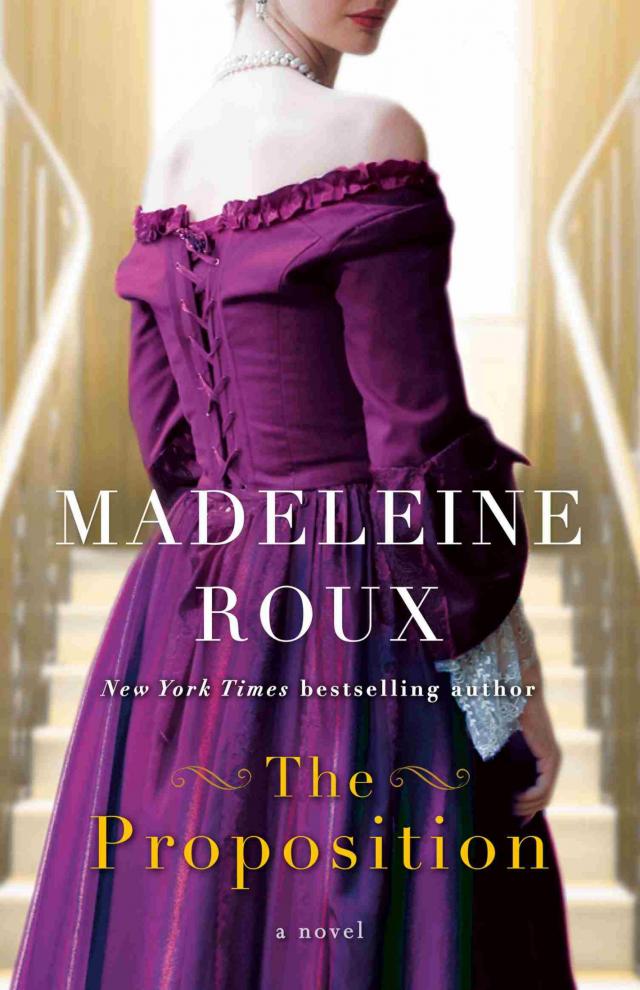
Cover design: Derek Walls
Cover images: © Jeff Cottenden (woman), © Laura Ranftler/Arcangel (stairway)
ep_prh_6.0_140577850_c0_r0
Contents
Cover
Title Page
Copyright
Epigraph
Chapter 1
Chapter 2
Chapter 3
Chapter 4
Chapter 5
Chapter 6
Chapter 7
Chapter 8
Chapter 9
Chapter 10
Chapter 11
Chapter 12
Chapter 13
Chapter 14
Chapter 15
Chapter 16
Chapter 17
Chapter 18
Chapter 19
Chapter 20
Chapter 21
Chapter 22
Chapter 23
Chapter 24
Chapter 25
Chapter 26
Chapter 27
Dedication
Acknowledgments
By Madeleine Roux
About the Author
To participate in matrimony is to abdicate one’s duty to the dignified state of solitude. Upon completion of the contract, a woman becomes property owned by man, surrendering all autonomy and power, diminishing herself in every conceivable way.
—Bethany Taylor, On Marriage
1
Sussex, 1819
The small and saintly quiet town of Round Orchard was never known for anything. Absolutely, it held the expected Sussex charm and the expected hedges and gardens, the expected paved town square decorated with the expected bunting and wreaths, but it was otherwise unremarkable in every way. That is, but for its one hidden claim to fame, which was known only to a few residents, and most of those would categorize this “claim” to be something less than attractive. In fact, it was now a closely guarded secret, like a bit of shameful tat kept in the lowest drawer under the heaviest blankets, a pet nobody loved buried in the backyard in an unmarked and shallow grave.
Like a brief and embarrassing infidelity.
All but one inhabitant of Round Orchard wished to hastily sweep this secret under the rug. Only young Clemency Fry remained the keeper of this tiny, hidden flame—the flame in question was a Miss Bethany Taylor, a woman of middling family and middlinger prospects. Some described her as “severe” and “a scold” while other more charitable Round Orchardians allowed that she had an intense sort of beauty that only specific and brave men coveted. This Miss Bethany Taylor produced and published a treatise against marriage, aimed at convincing other members of her sex that the institution was both humiliating and cruel. To participate in matrimony, wrote the severe scold of intense beauty Miss Taylor, is to abdicate one’s duty to the dignified state of solitude. Upon completion of the contract, a woman becomes property owned by man, surrendering all autonomy and power, diminishing herself in every conceivable way. Solitude is subsequently diminished also, as the state of contented aloneness cannot be improved upon—even a love match requires some degree of compromise. Thus, with society thrusting women into a state of compromise, only a single lady happy in her charms, her accomplishments, and the quality of her morals achieves a truly enviable state of being.
Marriage was, in Miss Taylor’s controversial and embarrassing opinion, a swindle: To marry was to give one’s self up; this could not be argued with. Nobody agreed with her except of course the keeper of her flame and one devoted reader, Clemency Fry. Clemency did not style herself a historian, but she did obsess over Miss Taylor’s work and felt nothing but conviction when it came to preserving the heart of the late Miss Taylor’s writings.
In the year 1801, the men of Round Orchard and surrounding towns were outraged and began an effort to quash all access to Miss Taylor’s work. Many fires were lit and many pages burned. The vicar at the time offered his restrained critique of the treatise, calling it, “A disgrace, an abomination before God, and an affront to the understood and natural order of things.” Some overheard him saying it made a case for “bringing back the stake,” though these remained unconfirmed rumors. A local man, urgently asked for comment, reportedly told a room full of good society that, “Miss Taylor, like all unmarriageable women, turns her pen against men rather than confront her own deficiencies.” The tirade continued for some time. “A real shrew,” the man concluded.
Scant copies of On Marriage, by Miss Bethany Taylor, remained after the predictable outcry and response. Word of its existence scarcely reached beyond the county. But as mentioned, one young lady, brought up in the small and saintly quiet town of Round Orchard, found a moldering copy of On Marriage in the woodshed one day. She was then eleven, and the papers had been stuffed into a suspected vermin nest. Despite the papers’ poor condition, Clemency Fry took them, dried them, smoothed them, and like a diligent restorer of ancient artifacts (but only just like one, for after all she was only eleven), painstakingly scraped away the mouse droppings and dirt until a somewhat legible and faintly stinking copy of On Marriage existed.
It was, as one might imagine, a formative experience for small Clemency Fry. Those redolent, faded pages were perhaps the last copy of On Marriage in the whole world, and they belonged to her, and she protected them, the solemn guardian of this most hated work.
So too did the reading of this treatise prove momentous for young Clemency.
Was it not so that marriage was unfair to women? Were the laws of property, of patrilineality, not by definition unjust? What, young Miss Fry longed to cry to the heavens, about women? Eventually it came to her mother’s attention that little Clemency was in possession of what was meant to be mere kindling, words that had become a very different sort of kindling. A young mind once ignited is difficult to snuff out, but Mrs. Fry gave it her best attempt. Mr. Fry, a generally frail and distracted person, failed to intervene, giving many the perception that the Fry children were left somewhat to run roughshod, with only the supervision of an overtaxed governess. A fearful and exasperated Mrs. Fry repeatedly threatened to confiscate what was “essentially poison” but she, seeing how dearly her daughter loved the dropping-stained relic, never had the heart to follow through on her threats. Still, she hoisted that same cudgel whenever Clemency acted out (which was frequently) and won a few battles, but by the time her daughter had become a young lady, Mrs. Fry had utterly lost the war. Reading Bethany Taylor led Clemency to an appreciation and study of Olympe de Gouges, and Mary Wollstonecraft, and so on, until Round Orchard secretly harbored another harbinger of rights for the fairer sex. Quelle horreur.
Mrs. Fry begged her daughter not to take after women who were “shrill and intolerable, scary, and probably up to a not insignificant amount of witchcraft.” After such strong language, a more obedient child might have been warned off the material and frightened, but then, Clemency had never been an obedient girl, nor a cowardly one.
She grew up to be an even less obedient woman.
* * *
—
Clemency Fry stared at the man who may be her husband while her flesh, her heart, her very soul turned as cold as the chilled salmon gelée jiggling on her plate. Whenever she glanced at him, at Turner Boyle, a flash of love passed before her eyes like a strike of lightning. His face, handsome in a fragile and cherubic way, elicited a momentary blast of warmth before the chill inevitably came on.
For in recent memory she had loved him, and, she felt reasonably certain, he had loved her. She had loved him somewhat against her will, her suspicion of marriage ever bolstered by the philosophy and feelings of Miss Bethany Taylor, her idol. Those words had formed a sort of protective armoring over Clemency’s heart, a padded gambeson of sense and control only lately pierced by the arrow of Lord Boyle’s affection. But now that affection was gone, and the arrow wound felt less like a wound of love and more like an infection that had begun to fester. None of that affection remained, not even a smear like the one on Lord Boyle’s plate, where his salmon had been.
Yet he smiled.
“Excellent as always,” Boyle crowed. He had a raucous pile of gingery hair that seemed always to style itself roguishly and fell in different attractive configurations whenever he ran his hand through it. It was a nervous tic of his, a tell, and he did it just then, as he no doubt felt Clemency’s eyes boring into the side of his cheek.
If Miss Bethany Taylor were there to see her in that moment, she would have withered and died all over again of embarrassment.
I am so sorry I did not listen, Miss Taylor. You were right all along.
After exchanging a dozen or so words at a party and six secretive letters, Lord Boyle pronounced them friends, adding that, “Friendship is a serious affliction; the most sublime of all afflictions, because it is founded on principle, and cemented by time.” She had been so impressed by his attempt to echo Mary Wollstonecraft that she had initially neglected to notice the error in the quotation. (Affection, not affliction. Obviously.) This failure she realized by and by was rather an epidemic of wishful thinking on her part vis-à-vis Lord Boyle. At any time, Miss Taylor’s ghost would stir from the loose earth of a Round Orchard graveyard and come to haunt her, and Clemency was convinced she would deserve it.
“Of course, you must serve the salmon at your wedding breakfast,” Mrs. Fry, her mother, crowed from the other end of the long, long table. A dozen dishes lay between them, her mother seemingly separated by an entire country’s worth of jellies, spreads, roasts, vegetables, and half-empty wineglasses. This out loud planning was all a bit hasty, thought Clemency, particularly when considering nothing official had been signed or announced. The snail’s pace of the whole affair being due to her father’s chronically poor health and spates of quasi-reclusion.
“I shall leave all of that to Clemency,” Boyle replied. He glanced in Clemency’s direction, but managed to land his eyes only on her gloved left hand. He had striking blue eyes and fair skin, but he looked even paler then, faced with the daunting possibility of eye contact. “She has all the taste and sense, and it is every young woman’s wish to dot every i and cross every t on the nuptial plans.”
She had forgotten she was holding a silver fork, and in that moment, hearing him lie so plainly to her own mother, she felt strong enough to bend it with the sheer power of her despair. At once, she was reminded of Jane Austen. Men of sense, whatever you may choose to say, do not want silly wives, wrote Austen. Well. Did women of sense want silly husbands? After all he was a baron, but now in her mind he no longer seemed like a serious person. Clemency’s fingers pinched the fork harder.
“Surely you cannot mean my daughter!” Mrs. Fry gave a polite titter. Clemency’s mother was an exact mirror image of her daughter, plus five and twenty years. They had the same oval face and full mouth, the same freckled skin and strawberry-blond hair, naturally wavy and styled into ringlets, and matching pale gray eyes.
Gray eyes that Lord Boyle had once called “arresting” but now could not be bothered to even meet. Her certitude in the folly of marriage had stood like a moat around her for her entire life, and Boyle had managed to build a bridge across it by simply disagreeing with her, relentlessly, in an amiable and starry-eyed way.
Marriage is foolish for others, Boyle had told her at a quiet gathering after she rebuffed him yet again. I am different. You are different. Together we can make a different sort of union.
“Clemency is dear and sometimes obedient, but it is miraculous that anyone at all could persuade her to marry,” Mrs. Fry continued.
Lord Boyle knew this, of course. Probably he had forgotten. Sometimes, when her rage was at its peak, Clemency fancied that he could not even remember her face, so little did he regard it now. But he knew that Clemency had always avoided matrimony. The ton had whispered that no man would ever conquer her, that her willfulness and disinterest in marriage would lead her to be a lifelong, and content, single woman. Clemency had never feared spinsterhood, and now she all but longed for it.
Lord Boyle had built a bridge across her moat, and now she had to wonder if that was all the fun there was to be had—in the building of the bridge, and the crossing it, in the winning of an unwinnable hand. Men did so enjoy games and gambling, pursuits of challenge and daring, and often in such things, gambling in particular, one must develop a flair for bluffing.
And he had bluffed her into the one thing she wanted least in life—marriage. Boyle of course knew this, as did the others seated at the table in Claridge House, the Fry family estate. To Clemency’s right, her elder brother, William, sat with his beloved wife, Tansy. They were too engaged in newlywed whispers to notice that Boyle had taken complete leave of his senses. Mr. Saines, a clergyman and family friend, was seated beside Tansy, his attention fixed on the sherry. On the other side of the table sat Clemency’s sister, a widow, Honora, quiet but listening. Their aunt and uncle, Mr. and Mrs. Drew, had come and were sandwiched between Honora and Turner Boyle.
Naturally, Clemency’s parents presided over the meal at the head and foot of the table. Mr. Fry sat to Clemency’s left, while Lord Boyle had been placed immediately across from her.
“Y-Yes,” Boyle was now stammering out, fluffing his hair nervously. The tell. “Indeed.”
“Clemency dear,” her father was saying in a whisper, “have mercy on your fork.”
“If I must,” she bit out, placing it with a tremble back on the cloth. Mr. Fry was having one of his rare good nights, and Clemency was glad for his presence. She often found herself missing him, though for some years he had been like a ghost haunting their home, pale and only occasionally glimpsed.
“How silly! Truly ridiculous.” Mrs. Fry was not going to drop Lord Boyle’s forgetfulness. She had seized on it, the one interesting development in the whole of dinner. “Our Clemency! Can you imagine it, Mr. Fry?” she all but screamed down the table. “Can you imagine it? Our Clemency! Eager to marry! No, no, it took a stalwart, persistent knight to storm that castle, and thank God for that, and thank God for you, Lord Boyle!”
Moat. Bridge. Clemency wrinkled her nose.
Mrs. Fry dissolved into rapturous laughter, and a few at the table indulged her, just as ready for some distraction from the screech of forks and knives across the dinnerware. Poor Mr. Fry did not so much as chuckle, his frequent bouts of gout and grippe leaving him tragically humorless. Boyle, however, threw back his gingery head and laughed with all his might, though to Clemency it sounded rather more like choking.
Without realizing it, she had picked up the fork again, this time in her fist.
“Dear…” Her father touched her left forearm lightly. He was a frail man in his sixties, snowy-haired and with a lined yet pleasant face. He possessed the soft, white luster of a cut turnip. “You must relinquish the fork, sweet girl, before anyone realizes your murderous intent.”
Clemency snorted, grateful for her father’s intervention. They shared a brief glance, and then she was laughing in earnest. She couldn’t stop. It was all too funny, too, too funny. And horrid. One full-bodied guffaw led to another, for the noise and feeling was neighbor to sobbing, and that she very much wanted to do. Eventually, everyone at the table noticed that she was laughing at something else entirely, utterly in her own world; her face and neck reddened as the sound threatened to resolve into crying.
“Clemency?” her mother shouted down the table. Out of the corner of her eye, she noticed Boyle wince. “Are you quite all right?”
“Oh! Yes!” Clemency at last found her voice, out of breath. She stood, shaking. “I am all right. In fact, I am splendid. Just…” She clapped her eyes on Lord Boyle, and the swiftness of it caught him off guard. At last they met eyes, and she watched him blanch, and freeze, and swallow a deeply sour mouthful of something. She hoped it lodged in his throat. “Just magnificent,” she said, stepping unsteadily away from the table, rattling the cups and plates. “If you will excuse me, I suddenly very much need to be sick.”