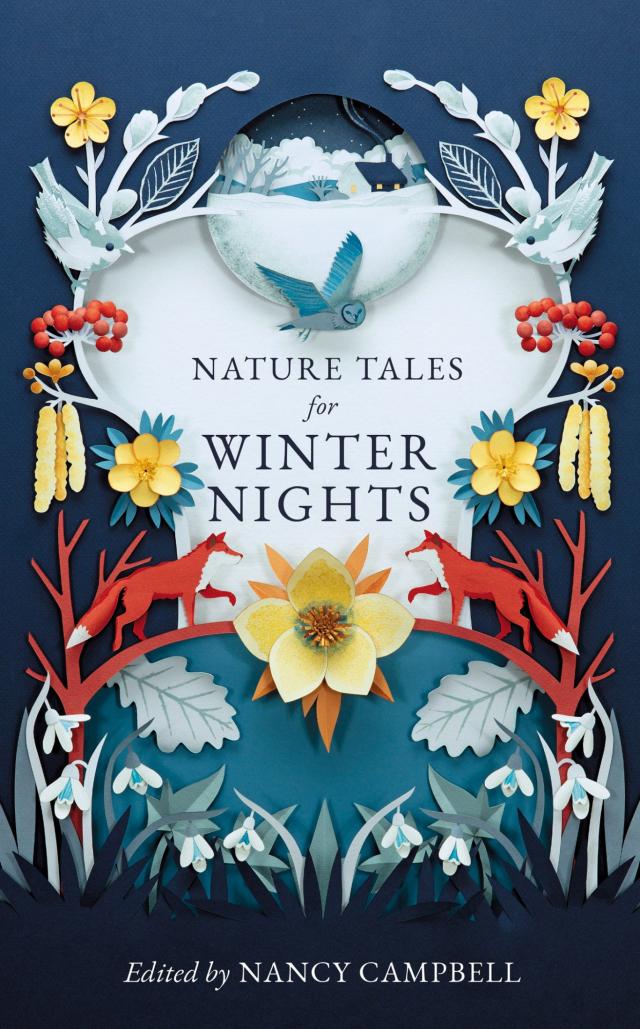
Nature tales for winter.., p.1
Nature Tales for Winter Nights, page 1


A sad tale’s best for winter […]
I will tell it softly;
Yond crickets shall not hear it.
WILLIAM SHAKESPEARE, A WINTER’S TALE
Contents
Introduction by Nancy Campbell
the wind
Anne Frank
snow mountains everywhere
Sei Shōnagon
cold burns and breaks
Olaus Magnus
a holly among hollies
Daisy Hildyard
a shadow
Charlotte Brontë
a winter day on the sea-beach
Walt Whitman
grace
Joy Harjo
a certain blueness about the lips
Virginia Woolf
the iceberg
Tove Jansson
to be done in the parterre, and flower-garden
John Evelyn
notes on a landscape
Theophilus Kwek
the raven and the goose
when the ravens could speak
the raven who wanted a wife
Inuit folktales
departure of HMS Beagle
Charles Darwin
relic of an expedition
Salomon Andrée
the rainy season
Daniel Defoe
foraging
Joseph Roth
berries
Varlam Tikhonovich Shalamov
a harsh winter
Mathilte Sørensen
a time to harvest
Damian Le Bas
the golden bough
James Frazer
yuletide
Marchelle Farrell
latin lockdown
Longus
a small bouquet
Beth Chatto
davos in winter
Robert Louis Stevenson
sea storm
Jorsias Ammonsen
the witch-hazel gatherer
Edwin Way Teale
a letter from the Netherlands
Vincent van Gogh
the message
Nancy Campbell
if winter comes can spring be far behind?
Alvin Aubert
into Spain and back again
Dorothy Pilley
books and other rations
Matthew Henson
a mountain ramble
Dorothy Wordsworth
the light
The Quran
a murmuration
Tim Dee
on nests
Susan Fenimore Cooper
encounter on the road of Hercules:Alpes Maritimes
Charlotte Du Cann
shelter in a snow-drift
Ernest Thompson Seton
sheep in winter
John Clare
the frozen river
Henry David Thoreau
a meteorological journal
John Rae
no ordinary snow-storm
Henry David Thoreau
from hedge to hedge
Charles Darwin
on snow-water
Carl Linnæus
a comfortable shelter
William Scoresby, Junior
a riddle
The Exeter Book
the wild wood
Kenneth Grahame
a meteor shower
Elizabeth-Jane Burnett
Beygja –bend. Djúpt –deeply.Halda –hold.
Sarah Thomas
Author biographies
Bibliography
Endnotes
Permissions
Acknowledgements
Introduction
the witching spells of winter nights
where are they fled wi their delights1
The old appointment diary was shabby and scratched, its corners bumped in my bag. The entries were marred by hastily scribbled meetings, obscure doodles; several leaves torn out for notes; a ribbon lost, a binding sundered. Delights had been in short supply. It was time for a new book to chart a course through the approaching winter and into the new year. A fresh diary, embossed in silver with a different combination of numerals, promised pages of days – days and days divided by a thin line. A week to view. The layout was regular and reliable, quietly formal; major festivals were noted, and the phases of the moon. I imagined designing a diary in which the lines between the blank days would grow broader and deeper, so that the division of light and dark on the page mirrored the shade of the skies that swung over my caravan in the woods, like the seeping dusk at 4 p.m.
At the winter solstice the clouds were heavy, chalk grey, the air still with snow that never seemed to fall. Without the generous canopy and riotous undergrowth of summer, my tiny home felt exposed. No leaves on the hawthorn hedge to offer protection from the wind, or dispel curious glances; in daylight, all my movements could be seen, and in the darkness any light cast from my van window betrayed my presence in the woods. Constellations turned above the thin roof and the long nights and short days sped past. People spoke of electricity being too expensive. Even candles were a luxury, and exchanged as precious gifts. I could feel a cold spell coming, and I was fearful.
Then came one of those moments of good fortune that offer as much solace to the weary soul as to the empty pocket. Before the freeze set in, an application I’d sent off months before for a research fellowship in a once-ruined now-restored castle was unexpectedly granted. With joyful anticipation I marked the approaching weeks away in the pages of the new diary. The fellowship promised shelter, sustenance and the camaraderie of other writers. A strange group we were, on our arrival in the shadowy seventeenth-century hall, our bright wheeled suitcases looked down on gloomily by the dusty portraits of great writers of the past. Each of us was lost in our own way, like a shipwrecked mariner with an ocean of time that we would need to design a unique vessel to navigate. Each of us determined to put this midwinter gift to good use, and hoping – for what? To finish books we had not found the time to write in our hours outside the castle walls, or to rest and dream new ideas into being. I knew what I wanted: to use this precious time of interiority to look outwards. I wanted to nestle into the words of others. I would read to travel deep into winter without suffering its dearth. I would read to summon the spring. I set no boundaries to my reading, knowing that sometimes the most necessary tales are found where we least expect them. The rambling castle library had never been catalogued, yet its shelves, which reached as high as the snowy pines in the forest beyond, seemed to hold every book I was looking for.
My first selection was a comforting choice. I picked out a book I remembered from childhood, and scurried back to my room with it. (After the confines of the caravan, I confess that I experienced a certain unease in those early days, my body negotiating its way up winding stone stairwells and along drafty corridors.) To re-read is a rediscovery of self as well as story, rather like the return of the seasons when our own lives have changed. My original encounter with The Shepherd’s Calendar, an acute survey of agricultural life, was the paperback, which travelled with us from house to house whenever my parents moved, always, along with kettle and tin-opener, one of the last possessions to go in a box, and soon unpacked again and set on the old wooden chest that temporarily took the place of a table. I loved the wood engravings depicting bare poplar branches and sheep huddled in snowy clumps, which separated the unpunctuated stream of verse into twelve distinct months. The poem was composed two hundred years ago, during the winter of 1823–24, by John Clare, son of a Northamptonshire farm labourer. Clare writes of the power of stories, when ‘Withering and keen the winter comes / while comfort flies to close shut rooms’. The opening lines describe the country people reading: farmers consulting newspapers for the price of grain, or even the more superstitious almanacs:
old moore’s annual prophecys
that many a theme for talk supplys
whose almanacks thumbed pages swarm
wi frost and snow and many a storm
and wisdom gossipd from the stars
of politics and bloody wars
The newspaper reports were still of wars and the cost of food. My colleagues in the castle and I had limited access to the internet, but despite relative isolation from current affairs we were not oblivious to our privilege in being held for a moment, comfortable in our close-shut rooms, safe from the anguish of conflict and disease. We worked in solemn silence during the day, and as dusk fell over the glen and the bright points of the winter circle pricked the north-eastern sky, we met for conversation, one by one quitting our desks and making our way to the drawing room where we could sink into saggy armchairs around the fire. Some missed their families; others relished their solitude after a long lockdown at close quarters with others. Candles were lit in the sconces. In this soft light, kindness and kinship hovered at the corners of the room as we spoke of books we loved in various languages, recommended other writers in and out of translation, read shyly from the first drafts of poems, and somehow, at some point, I stopped seeing time as something urgently demarcated by the lines in my diary, and began to feel the space open up between them.
These long evenings of conversation, free from the thousand distractions of technology, reminded me of a historian whose work I’d encountered in a polar museum. Mâliâraq Vebæk had recorded oral histories in Cape Farewell, Greenland, in the 1960s, where the inhabitants of isolated settlements ‘loved to tell creepy stories in the evenings after dark’. Such tr
and from her memory oft repeats
witches dread powers and fairey feats
. . .
thus dames the winter night regales
wi wonders never ceasing tales
The listening children ‘tremble while they love to hear / startling while they the tales recall / at their own shadows on the wall’. And it is no wonder they tremble. The turning of the year is the time of Janus, the ancient Roman god of doors, gateways and transitions: a cusp on which past and future balance. In Brittany and Wales, the intercalary days of the year – those left over from reckoning up the solar calendar, spare in every sense – are called the ‘Omen Days’. In this interval divinities are born or conceived in many mythologies (they equate to the Twelve Days of Christmas, for example) and the afterlife beckons to mortal souls. These hours are rich in apparitions and augurs and, according to the Scots Gaelic tradition of the fríth, on each of the twelve days those with second sight should wander outside to observe the signs in nature and use them, like images in the tarot, to divine events of the twelve months of the year to come.
My days in the castle gradually took on a routine. On frosty mornings, I would set out for a brisk walk to dispel the remnants of dreams before settling at my desk. Sometimes I snatched a slice of toast and marmalade on the way out the door, and munched it as I walked along the yew-lined avenue. A robin haunted my steps. It perched sometimes in the low branches of the holly outside the library window, and chittered for crumbs. Once or twice, it was sufficiently brazen to hop inside. I read about other species, which had found more reliable means of surviving winter’s dearth. From Edwin Way Teale’s classic Wandering Through Winter, I discovered that the only bird known to hibernate is the common whippoorwill, the smallest North American nightjar. Among the Hopi tribe, the bird is named hölchko or ‘the sleeping one’. From California to Mexico its distinctive call, a monotonous ‘poor will’ from dusk to dawn, grows silent as it settles into rock hollows and enters a state of torpor. Its heartbeat slows and its body stills until the cold season is past.
Hibernation is a miraculous spell of time akin to the transformations undergone by a shaman, whose spirit travels while their body is in trance. Likewise, hours spent in a library might seem to be a retreat from the world, yet promise encounters with a myriad voices. I was discovering in the words of others something I had almost lost myself: a hope for the coming spring. A temporary state of seclusion is a trope of many tales of regeneration. In Italy, the three coldest days of the year, which fall on the cusp of January and February, are known as i gioni della merla. The merla: a female blackbird, a species that does not migrate and must weather the winter storms. According to legend, the merla once had white feathers. During one particularly bitter winter, the canny merla sought warmth by sheltering in a smoking chimney stack, and emerged from her burning nest after three nights covered with soot particles – like the phoenix, transformed. From that time on, the birds’ feathers grew to be black as a sign of gratitude for their survival, and the bird itself has become a symbol of new life. A proverb from Bologna: ‘When the blackbird sings, winter ends.’
On paper, winter may have an official beginning and end and even a carefully orchestrated middle (the hour changes, calendars turn). Yet the parameters of the period are called into question as the weather we associate with the season becomes ever more capricious, due to the devastating effects of climate change. Solastalgia replaces nostalgia, when the snow scenes depicted on holiday cards are rarely seen in our neighbourhoods. After all, like love and death, the seasons are cultural constructs, experienced differently according to tales the ancestors have given us. Before the coming of Christianity to Iceland in the twelfth century, medieval farmers used the Norse calendar divided into just two seasons, summer and winter. These extremes seemed to be echoed in the situation of Defoe’s Robinson Crusoe who, after a year marooned near the equator, realises on ‘the unhappy anniversary’ of his landing that the island climate will offer only interludes of drought and of rain. In the polar regions, sea ice dictates the annual cycle: September, for hunters in Nunavut, is Akullirut, or the waiting season. ‘During this time there is snow on the ground and everyone is waiting for sea ice to form,’ the hunter Joelie Sanguya explains.2 In October – Amiraijaut – when the sea ice arrives from the north on ocean currents, the hunters know that ‘freeze-up’ is beginning. This is followed by Tusaqtuut (November) or ‘news time’: while travellers in Europe commonly see ice and snow as barriers to transport, at best a nuisance, something to be salted away, the sea ice allowed Arctic peoples to travel long distances between camps after months of separation and open water, bringing news of friends and family along with them. Despite these icy distinctions, across the waters of Baffin Bay, the West Greenlandic word for ‘winter’ and ‘year’ is the same (ukioq),3 suggesting the mood of the dark nights persists as an undertow through the rest of days.
For the Lakota people, a year ran from first snowfall to first snowfall. At the end of each year, on the snow’s return, elders chose a significant event to represent the whole year – unusual weather, or outbreaks of disease. These pictographic calendars are known as the ‘winter count’. (The term comes from the Lakhótiyapi name waniyetu or ‘winter’ and wowapi, ‘anything that can be counted’.) One person was appointed keeper of the count, and this individual was responsible for the symbols, which served as a mnemonic for oral historians’ more elaborate recall. (The count was traditionally painted on bison hides, although following the near-extinction of the bison in 1800, paper from old ledger books was used.) The winter count of Battiste Good4 denotes, for example, ‘the year the stars fell’ – 1834, when the Leonid meteor shower was notably bright – with a tipi surrounded by many stars.
Clearly, winter is a time for elders to pass on wisdom and instruct future generations in their history. The castle gardener taught me a Scots saying ‘many hawes, many snawes’: an abundance of white hawthorn blossom in the hedgerows indicates there will be severe snowstorms in the coming winter. Her words demonstrate how closely acts of augury are connected to traditional environmental knowledge and scientific understanding. I have always loved browsing works of natural history from the Enlightenment onwards, for insights into the ways humans across time have wondered at – and attempted to classify and describe – the more-than-human. Some of the close observations in these pages anticipate the work of contemporary ecologists. Charles Darwin watches glowworms beneath the Corcovado in Brazil during the winter of 1832, and Carl Linnæus considers the qualities of glacial water on a research trip in Lapland in 1732. These canonical voices may sound almost naive compared with the witty account of a wager on how long a snow mountain might take to melt, written over a millennium ago at the court of the Empress Teishi. Sei Shōnagon’s experience feels contemporary yet offers a stark contrast to the sorrow the same question prompts in the Anthropocene.
One day the tranquillity of the castle on its crag was disturbed by a storm so severe the Met Office had given it a name. As wind wailed down the gable chimney and shook the sash windows, and gusts of sleet prickled on the panes, the company around the hearth appealed for tales of even wilder weather, so that I found myself regaling the winter night in my dressing gown, not unlike Clare’s storyteller. It dawned on me that the passages on natural history I had been assembling were a sequence, not for myself alone, but a compendium that might accompany others through similarly long nights. In her novel Emergency, Daisy Hildyard describes how a line of holly trees on the crest of a Yorkshire hill exists to mark a way for walkers when winters were worse than they are now. ‘In those days, for weeks at a time, deep snow hid the paths and hedges so that all directions looked the same. Whoever had planted these trees had situated them with care: as you reached one, the next was in clear view, though the line wasn’t necessarily visible all at once.’ The process of compiling an anthology can feel a little like tracing a course from one evergreen to another. Walt Whitman praises the austere beauty of the Atlantic shoreline; across the ocean, Virginia Woolf presents Orlando in a liminal state as the River Thames freezes, falling in love with a slender androgynous figure: ‘whether boy’s or woman’s, for the loose tunic and trousers of the Russian fashion served to disguise the sex, filled him with the highest curiosity.’ Meanwhile the young Tove Jansson becomes infatuated with an iceberg, just for one night, and Daphnis and Chloe must contemplate a hiatus in their pastoral courtship.