An act of foul play a la.., p.1
An Act of Foul Play (A Lady Hardcastle Mystery), page 1


ALSO BY T E KINSEY
Lady Hardcastle Mysteries:
A Quiet Life in the Country
In the Market for Murder
Death Around the Bend
Christmas at The Grange
A Picture of Murder
The Burning Issue of the Day
Death Beside the Seaside
The Fatal Flying Affair
Rotten to the Core
Dizzy Heights Mysteries:
The Deadly Mystery of the Missing Diamonds
A Baffling Murder at the Midsummer Ball
This is a work of fiction. Names, characters, organizations, places, events, and incidents are either products of the author’s imagination or are used fictitiously. Any resemblance to actual persons, living or dead, or actual events is purely coincidental.
Text copyright © 2022 by T E Kinsey
All rights reserved.
No part of this book may be reproduced, or stored in a retrieval system, or transmitted in any form or by any means, electronic, mechanical, photocopying, recording, or otherwise, without express written permission of the publisher.
Published by Thomas & Mercer, Seattle
www.apub.com
Amazon, the Amazon logo, and Thomas & Mercer are trademarks of Amazon.com, Inc., or its affiliates.
ISBN-13: 9781542031486
ISBN-10: 1542031486
Cover design by Tom Sanderson
Cover illustration by Jelly London
Contents
Chapter One
Chapter Two
Chapter Three
Chapter Four
Chapter Five
Chapter Six
Chapter Seven
Chapter Eight
Chapter Nine
Chapter Ten
Chapter Eleven
Chapter Twelve
Chapter Thirteen
Chapter Fourteen
Chapter Fifteen
Chapter Sixteen
Chapter Seventeen
Chapter Eighteen
Author’s Note
Acknowledgements
About the Author
Chapter One
I’ve never been entirely sure of the reason for the interval at the theatre. Is it that the actors desperately need a rest after all that standing about and talking? Do all the audience members really need to visit the insufficiently provisioned toilets? Can no one survive an extra hour without a glass of disappointing wine?
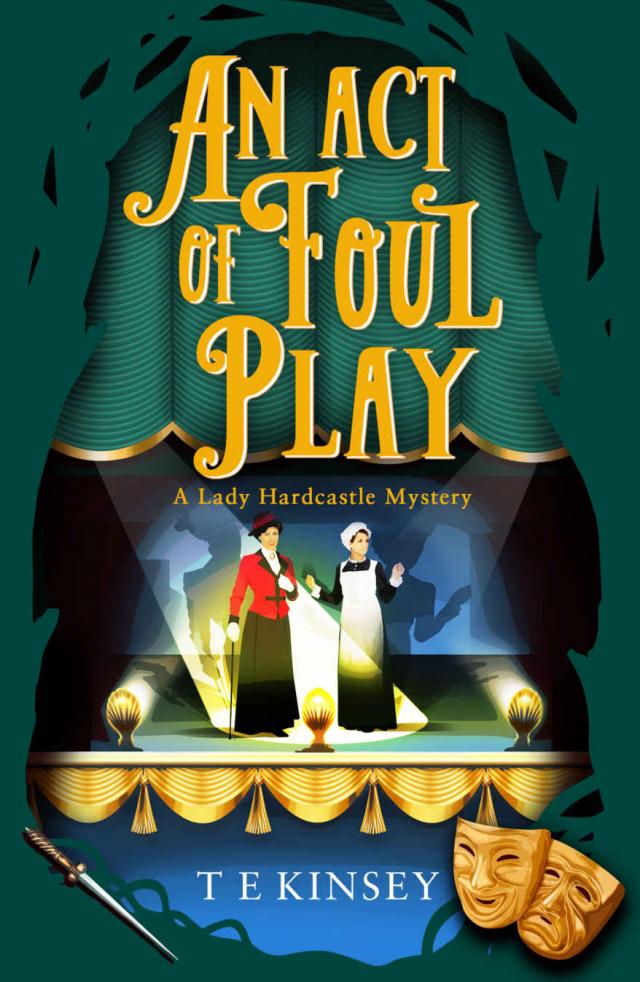
It was Lady Hardcastle’s birthday and she had invited her Bristol friends to join her for a celebratory meal at Le Quai, a French restaurant which had opened in the city at the end of the summer and had instantly become the place to eat. Among the invitees was our suffragette friend, Lady Bickle, who had further suggested that we begin the evening with a trip to see her friend’s play, which was being performed to enthusiastic reviews at the Duke’s Theatre.
And so it was that our party had descended upon Frogmore Street in our finery to join Bristol’s theatregoers in an evening of ‘riotously mirthful entertainment’, as the Bristol News’s critic had put it.
He wasn’t wrong. By the interval I found that I’d been laughing so much that my cheeks were hurting, and I was glad of the rest. Perhaps that’s what intervals are for after all, though it wouldn’t explain the need for them during a melodrama or a morality tale.
Whatever the justification for the break, as the curtain fell on the first act, the laughter and applause died down and almost everyone rose to leave. I found myself alone in the box as my companions joined the crush to exit the auditorium to meet their own intermissionary needs.
Lady Bickle and her husband, Sir Benjamin, set off for the bar. Inspector Sunderland and his wife, Dolly, didn’t announce their intentions, which I took to mean that they were bound for the lavatories. Local journalist Dinah Caudle and her fiancé, Dr Gosling, the police surgeon, mulled their options for a short while before they, too, decided on the bar.
Lady Hardcastle, of course, wanted both.
‘Are you coming, Flo?’ she said.
‘I’m fine, thank you,’ I said with a smile. ‘I might get up and stretch my legs in a bit.’
‘As you wish, dear.’
She joined the others.
I swapped seats for a better view and leaned forwards on the padded rail to look about the auditorium. The Duke’s Theatre was a decent size but it somehow still managed to have a pleasing intimacy. It was a wonderful building and I had always loved going there, most especially when the show was a good one. And this one had been utterly joyous so far. Lady Bickle’s friend, Hugo Bartlett, was a splendidly funny writer, and the cast brought his words to life with such wonderful skill that I hadn’t wanted the first act to end.
The safety curtain was down, concealing the source of the bangs and clatters coming from the stage and making them all the more intriguing. In truth I knew they were just evidence of the hard work of the unseen, under-appreciated stagehands, but I liked to imagine something a little more mysterious.
The Sunderlands were the first to return.
‘That was quick,’ I said.
‘There was a queue,’ said Mrs Sunderland.
I nodded. There was always a queue.
There were more clatters and rumbles from behind the safety curtain.
‘I’ve always wondered what goes on back there,’ said Inspector Sunderland as he took his seat. ‘You must have an idea, Miss Armstrong. Circuses and theatres can’t be as different as all that.’
‘I don’t suppose they are,’ I said. ‘In which case I imagine that horny-handed sons of toil are hefting furniture and scenery about, then holding it all down with twenty-eight-pound cast-iron weights. Which they probably drop—’ There was another massive bang. ‘Like that.’
‘What an exciting life you’ve led,’ said Mrs Sunderland. ‘I do envy you sometimes, you know.’
‘It’s had its moments,’ I said.
‘It most certainly has,’ she agreed. ‘You’ve done so many wonderful things and travelled to so many wonderful places. I’ve never been further from home than Brighton.’
‘We went there for our honeymoon,’ explained the inspector.
Mrs Sunderland touched his hand.
‘And what a lovely time we had,’ she said. ‘But I’d still love to visit some of the places you and Emily talk about.’
‘I’ve been very lucky,’ I said. ‘The only disadvantage is that I have to do it all in the company of you-know-who.’
Mrs Sunderland laughed.
‘You are dreadful,’ she said. ‘I’ve never met two better friends.’
There was movement behind us. I turned to see who had returned.
‘Speak of the devil,’ I said.
‘Should my ears be burning?’ said Lady Hardcastle.
‘I was just saying what a terrible old bag you are,’ I said.
‘Quite right, too,’ she said. ‘Though there was a time when servants would be more discreet about their employers’ failings.’
‘Surely you wouldn’t want me to lie,’ I said.
‘You make a good point. Budge up now, though, there’s a poppet. Let the old bag rest her weary pins.’
I shuffled back into my own seat.
‘You weren’t gone nearly as long as I expected,’ I said.
‘Queues, dear. As far as the eye could see. Serried ranks of cheerful theatregoers waiting patiently to either empty themselves or fill themselves according to their needs or desires. I weighed it all up and decided that the interval would be more entertainingly spent in the company of my friends than among strangers. By the time I’d made my way to the front of the second queue, I’d have no time to drink my brandy anyway because the play would be over.’
‘It’s a very funny play, don’t you think?’ said Mrs Sunderland. ‘Georgie’s friend is so clever.’
‘The mysterious Hugo Bartlett,’ said Lady Hardcastle. ‘Has anyone met him?’
The Sunderlands shook their heads.
‘Lady Bickle said she’d introduce us after the show,’ I said. ‘We can all compliment him on his brilliance then.’
‘Georgie has led a fascinating life, too,’ said Mrs Sunderland, wistfully. ‘Why have I not led a fascinating life, Ollie?’
‘Because you were foolish enough to marry an ambitious young policeman,’ said the inspector. ‘He held you back and condemned you to a life of mundanity and ordinariness.’
She touched his hand again, this time adding an affectionate squeeze.
‘I wouldn’t change it for the world,’ she said.
We settled into companionable silence and leafed through our programmes as we waited for the second act to begin.
We waited.
Time hangs heavy when you’re waiting for a performance, but this interval really did seem to be taking for ever. People who had returned in good time, possibly before they had fulfilled whatever need had driven them out of the auditorium in the first place, were chattering irritably. I heard the phrases ‘bloody long time’ and ‘I wish they’d get on with it’ floating up from the stalls. One or two of them got up and went out again.
Eventually we heard the sound of the interval bell, and the auditorium rapidly refilled.
The grumbling was replaced by an excited murmuring, which gradually grew as people took their seats and chattered animatedly to their companions, in appreciation of the entertainment so far experienced and in a
There was a subdued, almost ironic cheer as the safety curtain rose to reveal the still-closed, red-velvet tableau curtains. There was a loud noise from behind them as a piece of furniture was shoved into position on the stage at the last minute.
After a few moments more, the house lights dimmed and we all, for reasons I still can’t explain, applauded enthusiastically. The door opened behind us, letting in light from the corridor and eliciting tuts of disapproval from several people in the stalls, who, quite by chance, had managed to take their places only a few moments earlier. People, I firmly believed, who would never have noticed if they’d been looking at the stage instead of gawping at the boxes. The door closed and the four missing members of our party shuffled to their places in the darkness. They clumsily resumed their seats and a man in the fifth row of the stalls looked up.
‘Will you be quiet!’ he said, sternly.
The curtains swept apart to reveal a new set. Act Two, we now saw, was to take place around a large round table in the corner of the ballroom, in the aftermath of the party the four characters had been preparing for throughout Act One. On the table there were champagne bottles upended in ice buckets, empty glasses, and several plates containing the half-eaten remains of a buffet supper. The chairs were askew, as though the four friends had all jumped up for one last dance.
Or three of them, at least. One of the group was lying on his back, downstage left, with a stage dagger protruding from his chest and a very convincing bloodstain spreading across his evening shirt. The play had taken a darker turn than I was expecting.
Few others had been expecting it, either, and there were one or two gasps from the audience, and a rushing whisper like wind in a wheat field as people expressed their surprise at this new development.
The three remaining friends – one man and two women – entered stage left, chattering and laughing as though returning from the dance floor.
‘I say, Bertie,’ said the man, ‘you missed a sight there. Didn’t he, girls? Old Biffy Blenkinsop was trying to kiss—’
He was cut short by a scream from one of the women as she noticed the body on the stage.
I’ve never been terribly convinced by women in books and plays who scream when they see a dead body. I know my life as a lady’s maid, part-time spy and full-time nosy parker has brought me into contact with more dead bodies than the average woman will see in . . . well, ever . . . so I might very well have become inured to it, but I’ve never once screamed. I’m more likely to say, Oh no, not again.
It was a testament to the actress’s skills, though, that her shock seemed entirely real. I had turned to Lady Hardcastle to comment on her convincing portrayal of a horrified woman when I noticed the other actress making frantic gestures towards the wings. As the curtains swished closed, the actor strode towards his colleague and we heard, ‘Good lord,’ before they closed completely.
There was a moment’s shocked silence from the audience, but then the hubbub started as the house lights came up.
Once the audience could see their companions, the speculation began. What was going on? Was it a real dead body? Had someone been murdered? Several people tried to push their way out, but their progress was halted by the mass of the curious who wanted to stay and find out what was going on.
Inspector Sunderland was already out of his seat.
‘That looked . . . well, it looked real,’ he said. ‘I’d better go and have a—’
He stopped talking as the curtains ruffled and a man in evening dress fought his way through the gap to appear on the stage. He held up his hands for silence and the audience quickly quietened.
‘Ladies and gentlemen,’ he began. ‘I’m afraid this evening’s performance of The Hedonists will not be continuing. We apologize for spoiling your evening. Your tickets can be refunded at the box office, or exchanged for tickets for a later performance. Once again, we apologize for the disappointment.’
The disappointment manifested itself in the form of a loud groan from the audience, with one or two shouted questions about what was going on – but, strangely, no one moved.
The inspector was still on his feet. He approached the balustrade of our box and leaned forwards.
‘Excuse me, sir,’ he said in a loud, clear voice. ‘Inspector Sunderland of Bristol CID. Would you mind telling us what has happened?’
‘Inspector?’ said the man, shielding his eyes against the spotlight that was now shining on him. ‘Would you mind awfully joining us on stage, please? Your colleagues from the police station are on the way.’
His comment elicited a fresh hubbub, this time tinged with alarm.
The man on the stage held up his hands again for silence, but the commotion just grew louder. Inspector Sunderland also needed silence.
‘Ladies and gentlemen,’ said the inspector. ‘May I have your attention, please.’
He was ignored.
‘Ladies and—’
I tapped his arm and indicated that I would deal with it. I put my fingers in my mouth and let out an ear-piercing whistle.
In the shocked silence that ensued, the inspector continued. ‘Ladies and gentlemen. It seems that this has become a police matter, so I would ask that you all remain in your seats for a while longer. Mr . . . ?’
The man on the stage realized he was being addressed.
‘Adlam,’ he said. ‘Edwin Adlam. I’m the theatre manager.’
‘Mr Adlam, would you be so kind as to instruct your staff to man the doors until my colleagues arrive. No one should leave the theatre.’
The hubbub was replaced by angry shouting.
The inspector waited for it to die down.
‘If this is as serious as it appears,’ he continued, ‘it is essential that we speak to each of you.’
‘I’ve got to get home,’ called the man from the stalls who had told us to be quiet. Several people agreed with him that they, too, needed to get away.
‘And I i’n’t stayin’ ’ere if there’s a murderer on the loose,’ said another.
This set off another round of panicked conversations and renewed efforts to leave the theatre.
‘And you shall,’ said the inspector. ‘My colleagues will be here in just a few moments, and you’ll be free to go long before the scheduled end of the play.’
The hubbub grew again, but curiosity and instinctive obedience to the instructions of authority overcame fear, and even those who had been most keen to leave resumed their seats. The inspector turned to us.
‘I’d better get backstage,’ he said. ‘Gosling? I think you might be needed.’
‘Right you are,’ said Dr Gosling. ‘Excuse us, all. We’ll be back as soon as we can.’
The two men made their way out of the box to where a member of staff was already waiting to take them backstage.
For a while, people were sullenly compliant and remained seated. There were occasional expressions of fear and concern, and a good deal of irritation that they were being prevented from leaving the theatre, but from the one or two conversations I could overhear clearly it seemed that there was a grudging acceptance of the inspector’s logic: if the play had gone ahead they’d be sitting in their seats for another hour anyway, so they weren’t actually being delayed at all.
What the inspector had neglected to consider, though, was that had they been watching the play they’d have been pleasantly distracted by the on-stage hilarity and the hour would have flown by. As it was, they were left with nothing to entertain them and the mood gradually shifted from disturbed disquiet and resentful resignation, through impatient irritation, and on to aggrieved agitation.
People had begun standing and looking around, with many engaging their neighbours in conversation about how dreadful it was that we were all being kept there. Standing led to moving, and one or two of the more belligerent patrons approached the auditorium doors, where they were politely but firmly invited by the theatre staff to return to their seats.
Mrs Sunderland, though, was troubled.
‘Who could have done such a thing?’ she said.
‘If anyone can find out,’ said Lady Hardcastle, ‘it’ll be your Oliver.’ She smiled. ‘Do you know, in all the years I’ve known him I’ve never called him that to his face? He’s always Inspector Sunderland to me.’
‘He laughs about you trying to get him to call you Emily, too,’ said Mrs Sunderland. ‘I told him not to be so silly, but he won’t have it. I think you’ll always be Lady Hardcastle and Inspector Sunderland, dear.’